A pliers wrench is the better choice for turning nuts, bolts, flat-sided fittings, and finished hardware without leaving tooth marks. Tongue-and-groove pliers are better for gripping large, round, irregular, dirty, or damaged parts where a serrated bite matters more than protecting the surface.
Neither tool is a complete replacement for the other. If you need one first adjustable-jaw tool for rough plumbing, pipe, drain fittings, and general grabbing, tongue-and-groove pliers are usually more versatile. If your work more often involves hex fasteners, compression fittings, appliance connections, and visible fixtures, a pliers wrench is the more controlled option.
The Core Difference: Smooth Parallel Jaws vs. Serrated Gripping Jaws
The important difference is not simply that both tools adjust. It is how their jaws hold a workpiece.
A pliers wrench has broad, smooth jaws that close nearly parallel. When adjusted correctly, the jaws contact multiple flat surfaces at once. This makes the tool useful on nuts, bolts, fittings, and thin sheet material that could be marred or distorted by teeth.
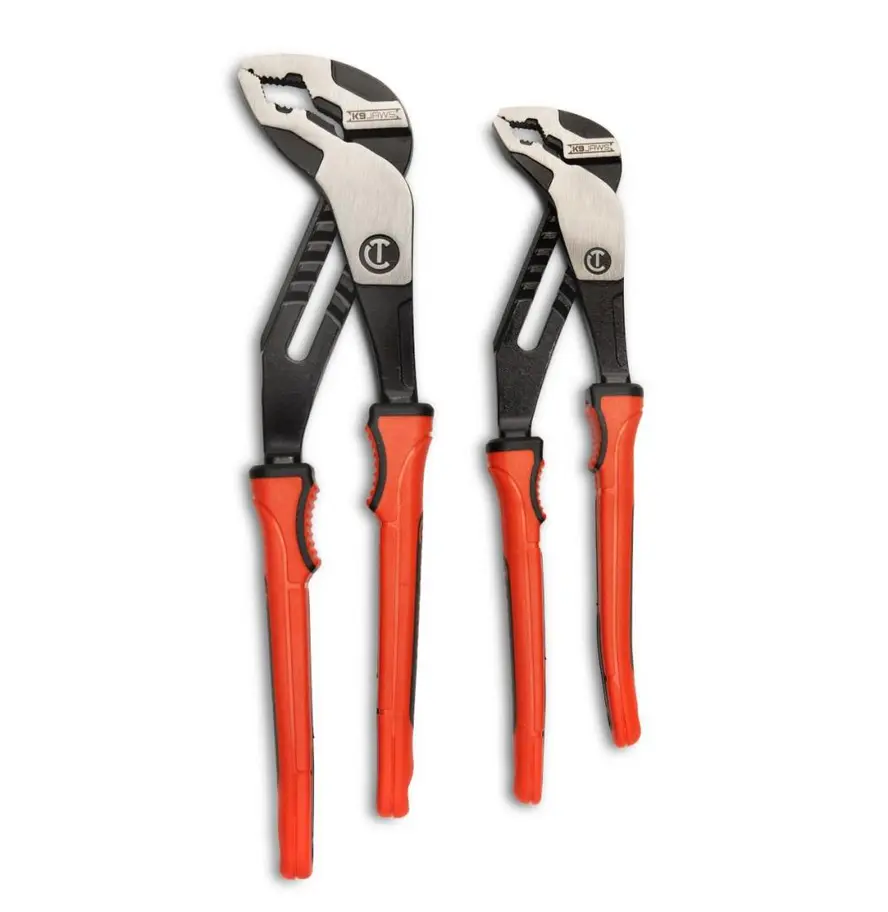
Tongue-and-groove pliers, also called water-pump pliers or channel-style pliers, use a sliding joint with several jaw positions. Their jaws are typically curved and serrated. The teeth concentrate gripping force and help the tool hold round pipe, rough fittings, odd shapes, and worn hardware.
Quick Comparison
| Job or material | Better tool | Why |
|---|---|---|
| Hex nuts and bolts | Pliers wrench | Smooth jaws contact the flats without biting into them. |
| Compression nuts and flat plumbing fittings | Pliers wrench | Less likely to scar a finished surface when properly sized. |
| Large plastic drain unions | Usually tongue-and-groove pliers | Wide adjustment range helps with oversized, round fittings; use light pressure to avoid crushing plastic. |
| Round pipe or rough pipe fittings | Tongue-and-groove pliers | Curved serrated jaws grip shapes that smooth jaws can slip on. |
| Rusted, damaged, or rounded hardware | Tongue-and-groove pliers | Teeth can grab where a smooth tool has little purchase. |
| Chrome or polished fixtures | Pliers wrench, or another surface-safe tool | Serrated jaws can permanently mark finished surfaces. |
| Flattening, pressing, or bending small parts | Pliers wrench | Broad smooth jaws distribute pressure more evenly. |
| Holding an irregular object while another tool turns it | Tongue-and-groove pliers | The jaw geometry is made for general gripping. |
When a Pliers Wrench Is the Better Tool
A pliers wrench works most like an adjustable wrench combined with pliers-style leverage. Its smooth jaws make it especially useful when the part has flat sides and appearance matters.
Nuts and bolts
For accessible hex nuts and bolts, a correctly sized box wrench, socket, or open-end wrench is generally the preferred choice. Those tools are shaped specifically for fasteners and are less likely to slip or damage corners.
But a pliers wrench is useful when you do not have the exact wrench size, when the fastener is in a place where an ordinary adjustable wrench is awkward, or when you need a compact tool that covers many sizes. Set the jaws so they fully contact the flats before applying force. Do not use the tool loosely on the corners of the nut.
Plumbing fittings with flat sides
Pliers wrench uses often include compression nuts, supply-line fittings, faucet hardware, and other flat-sided connections. The smooth jaws are a major advantage on brass, plated, painted, and finished parts that serrated jaw pliers would mark.
That does not mean every plumbing fitting should be tightened with one. Plastic components, thin-wall fittings, and sealed connections can be damaged by over-tightening. Check the current installation instructions for the fixture or fitting before making a final tightening adjustment.
Appliance and household repairs
A pliers wrench can be useful for turning locknuts, leveling-foot nuts, furniture hardware, hose-end fittings with flats, and similar household parts. It also works well for gently holding or straightening small metal brackets because the smooth jaws do not intentionally bite into the material.
Pressing and light shaping
The parallel jaw action can help press clips, flatten bent tabs, or hold a small part while fitting it into place. Use controlled pressure. A pliers wrench is not a substitute for a bench vise, press, or purpose-built forming tool when substantial force is needed.
When Tongue-and-Groove Pliers Are the Better Tool
Tongue-and-groove pliers excel when the workpiece is too large, too round, too irregular, or too damaged for smooth jaws to hold reliably. Their large adjustment range is often their biggest advantage.
Pipe, drain parts, and rough plumbing work
Tongue-and-groove pliers are commonly used to hold pipe, turn larger drain connections, grip shutoff valves, and manage rough plumbing hardware. Their curved jaws wrap around round stock more effectively than the flat jaws of a pliers wrench.
Use care on plastic drain fittings and trap assemblies. Serrated teeth can gouge plastic, and excessive squeezing can deform threads or crack an aging part. For visible chrome fittings or delicate finished surfaces, a strap wrench or a suitable protective method may be a better choice.
Irregular, damaged, and rusty parts
Serrated jaw pliers are often the practical option when a nut is already rounded, a fitting is corroded, or the part has no clean flat surfaces. The teeth can grip material that a pliers wrench cannot hold.
The tradeoff is damage. Serrated jaws intentionally dig into the workpiece. Use them when preserving the part’s finish is less important than getting a secure grip, or when the part is being replaced.
Holding rather than turning
Tongue-and-groove pliers are particularly useful as a holding tool. For example, they can hold a pipe or fitting steady while you turn a separate nut with the correct wrench. This two-tool approach can reduce stress on connected plumbing and gives you better control than trying to turn everything with one pair of pliers.
Can a Pliers Wrench Replace Tongue-and-Groove Pliers?
Not fully. A pliers wrench can replace tongue-and-groove pliers for some flat-sided fittings and many ordinary fasteners, especially when surface protection matters. It cannot match the bite and shape control of serrated jaws on large round pipe, irregular objects, or heavily damaged hardware.
Likewise, tongue-and-groove pliers can turn many nuts and fittings, but they are a poor substitute for a pliers wrench on finished hardware. Their teeth can leave permanent marks, and their jaw shape does not support a hex fastener as evenly.
Think of the choice this way:
- Choose a pliers wrench when you need to turn or press a part cleanly.
- Choose tongue-and-groove pliers when you need to grab a part securely.
- Choose a dedicated wrench or socket when the fastener is accessible and you have the correct size.
Which One Should You Buy First?
For a first adjustable-jaw hand tool, choose based on the repairs you actually do.
Choose tongue-and-groove pliers first if you expect to work on drain pipes, hose connections, rough plumbing, sprinkler parts, outdoor equipment, or miscellaneous round and irregular objects. They are the broader general-gripping tool.
Choose a pliers wrench first if your projects involve furniture assembly, appliances, bicycle or light mechanical work, fixture installation, compression fittings, and visible fasteners that you do not want to scratch. It is the more finish-friendly tool for flat-sided work.
A basic home tool kit often benefits from both over time. If you are building one gradually, start with the tool that matches your most likely jobs, then add the other when you encounter its limitations. For other foundational tool choices, see /basic-home-tool-kit/.
Common Mistakes to Avoid
Using serrated jaws on decorative finishes
Tongue-and-groove pliers can scar chrome, polished brass, painted hardware, and soft metal. Covering a part may reduce cosmetic damage, but it can also make the grip less secure. Use a purpose-appropriate surface-safe tool when the finish matters.
Gripping only the corners of a nut
Whether using a pliers wrench or tongue-and-groove pliers, poor jaw placement can round a fastener or cause the tool to slip. A pliers wrench should sit squarely on the flats. If it cannot, switch to a better-fitting wrench, socket, or another suitable tool.
Treating either tool as a pipe wrench
Tongue-and-groove pliers can grip many pipe-related parts, but they are not automatically the right choice for every pipe job. Pipe material, fitting type, connection method, and available clearance all matter. Check the pipe or fitting manufacturer’s current instructions before applying substantial force.
Adding extra leverage
Do not extend the handles with a pipe or other improvised cheater bar unless the current tool manufacturer documentation specifically permits it. Extra leverage can damage the tool, break the workpiece, or cause a sudden slip.
Working on energized equipment
Do not use ordinary pliers on energized electrical components. Verify the current tool documentation, equipment instructions, and applicable electrical safety guidance before working near electrical systems.
Safe Use Basics
Adjust either tool before loading it, and make sure the jaws are fully seated on the workpiece. Keep fingers out of the jaw area and position yourself so a slip will not pull your hand into a sharp edge, fitting, or nearby surface.
Pulling with controlled force is generally easier to manage than pushing, provided your position and the work area allow it. Avoid forcing seized components. If a fitting will not move, reassess the tool choice, look for hidden retaining parts, and consult the current manufacturer instructions for the assembly.
Inspect the jaws, pivot, and adjustment mechanism before use. Worn teeth, loose joints, bent handles, or jaw damage can make either tool less secure. Replace or service a damaged tool according to the manufacturer’s current guidance.
Bottom Line
A pliers wrench is the better adjustable-jaw tool for nuts, bolts, flat fittings, and finished surfaces. Tongue-and-groove pliers are the better tool for large, round, irregular, rusty, or damaged objects that need a strong serrated grip.
If your main question is whether one can replace the other, the answer is no. A pliers wrench protects and turns; tongue-and-groove pliers bite and hold. The right choice depends on whether the job demands clean contact on flats or secure grip on difficult shapes.
References
- Wrench vs Pliers Explained: When to Use Each Tool. (n.d.). https://ronixtools.com/en/blog/wrench-vs-pliers
- Tongue-and-Groove Pliers: How They Work & Examples | FIRGELLI. (n.d.). https://www.firgelliauto.com/blogs/mechanisms/tongue-and-groove-pliers
- Tongue and Groove Joint Pliers | Chinese Manufacturer. (n.d.). https://plierpincer.com/pliers/tongue-and-groove-joint-pliers
- r/Tools - pliers wrench vs adjustable. (n.d.). https://www.reddit.com/r/Tools/comments/1ecb3q3/pliers_wrench_vs_adjustable
- Locking pliers vs tongue and groove. (n.d.). https://bobistheoilguy.com/forums/threads/locking-pliers-vs-tongue-and-groove.410292
- Types of Pliers. (n.d.). https://www.homedepot.com/c/ab/types-of-pliers/9ba683603be9fa5395fab90be0e9605
- Types of Pliers - Essential Hand Tools for Various …. (n.d.). https://www.facebook.com/groups/391055213354730/posts/982161340910778
- Best Pliers (TONGUE & GROOVE)? Knipex vs Fujiya, Irwin, Klein Tools, Channellock, Doyle. (n.d.). https://www.youtube.com/watch?v=qjDG4gaiRp8
- How To Choose and Use Pliers and Wrenches - This Old House. (n.d.). https://www.thisoldhouse.com/tools/how-to-choose-and-use-pliers-and-wrenches
- Adjustable plier comparison – Cool Tools. (n.d.). https://kk.org/cooltools/adjustable-plier-comparison
 Why Tongue-and-Groove Pliers Do Not Stay Clamped
 How to Sharpen a Wood Chisel: Flatten, Hone, and Test the Edge
 How to Measure and Mark Long Boards When Working Alone