For cutting up small collected branches and fallen limbs, a mini chainsaw is usually the faster, lower-effort choice when most of the work is wood cutting. A reciprocating saw is often the better choice when you already own one for repairs and want one cordless tool for branches, plastic, fasteners, and demolition-type jobs—but it generally transmits more vibration and can take more effort to hold steady in wood.
For a homeowner who wants a manageable tool rather than maximum cutting capacity, start with the job. Choose a mini chainsaw for repeated ground-level branch cutting and routine yard cleanup. Choose a reciprocating saw for occasional limbs, awkward access around a pile, and mixed household work. Neither tool is a substitute for safe high-reach pruning or professional tree work.
Quick comparison
| Task or concern | Mini chainsaw for pruning | Reciprocating saw for tree branches |
|---|---|---|
| Repeated cuts in collected limbs | Usually the more efficient option | Works, but can be slower and more tiring |
| Small branches and light cleanup | Very well suited | Well suited with a pruning blade |
| Larger or denser limbs | Generally the better fit within the saw’s manual-rated limits | Can cut them, but vibration, blade flex, and time may increase |
| Green, freshly cut wood | Designed primarily for this work | Needs a coarse blade intended for pruning or green wood |
| Dry, dirty, or reclaimed wood | Chain may dull more quickly if the wood contains grit or embedded debris | Blade can also be damaged; inspect wood before cutting |
| Vibration and fatigue | Cutting action is typically smoother once the chain is engaged | Reciprocating motion can feel noticeably harsher over repeated cuts |
| Precise work near obstacles | Requires room for the bar and attention to where the chain travels | Long blade can reach into gaps, but may flex or snag |
| Other household uses | Mostly limited to wood and yard work | Highly versatile with the correct blade |
| Routine maintenance | Requires attention to the chain, bar, lubrication system, and battery | Requires blade changes and general tool maintenance, but no chain system |
The practical choice for downed branches
If your main job is reducing a pile of limbs into manageable pieces for disposal, a battery pruning saw is usually easier to live with. It cuts quickly, so you spend less time holding the tool against each branch. That matters when there are many similar cuts to make.
A mini chainsaw also tends to be the more natural tool when branches are thick enough that hand loppers become slow or difficult. It is purpose-built for wood, while a reciprocating saw is a general-purpose tool adapted to wood cutting with the right blade.
That does not mean a mini chainsaw is automatically easier for every person. Compact pruning chainsaws can be light, but their cutting chain remains exposed during use and requires deliberate control. Read the current manufacturer manual for the exact model, including its intended grip, cutting orientation, inspection steps, chain care, battery instructions, and required protective equipment. Do not assume a compact saw is meant to be used one-handed just because it is small.
When a reciprocating saw is the better fit
A reciprocating saw makes sense when branch cutting is occasional and the tool will also earn its place elsewhere. With suitable blades, it can handle a range of repair and cleanup tasks that a pruning chainsaw cannot.
It can also be useful when a limb is lying in a position where the narrow blade can reach into a gap more easily than a chainsaw bar. For example, it may help separate a branch from a brush pile without moving the entire pile first—provided the branch is stable and the blade has a clear path.
For tree branches, use a blade specifically labeled for pruning, green wood, or wood with nails only when that matches the manufacturer’s application guidance. A coarse pruning blade clears wood fibers more effectively than a fine blade intended for metal. Verify that the blade shank, length, and intended material match your saw’s current manual.
The tradeoff is fatigue. A reciprocating saw moves the blade back and forth rather than making a continuous chain cut. On small material this may be perfectly acceptable. On a long cleanup session, the vibration and repeated pushing against the branch can become the deciding drawback.
Branch size matters, but condition matters too
Do not choose solely by a branch’s measured diameter. Wood condition and support can make an easy-looking cut difficult.
Fresh green branches are often fibrous and springy. Dry limbs may be harder, brittle, or more likely to crack unexpectedly. Fallen wood may have soil, stones, wire, nails, or other contamination that can damage a chain or blade. Branches resting on other limbs can shift as sections are removed.
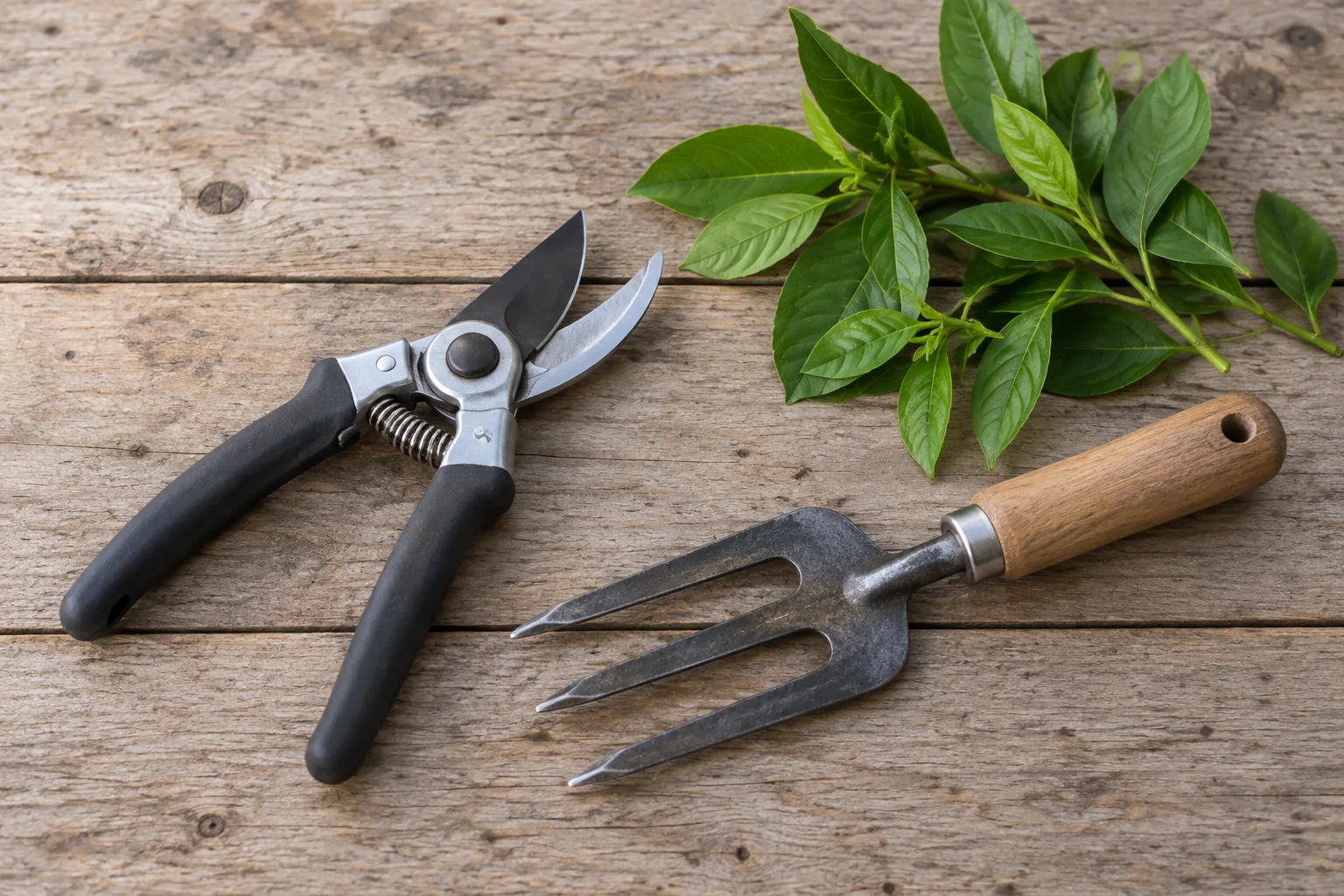
For very thin branches, bypass pruners or loppers are usually quieter, simpler, and more controlled than either power tool. For moderately sized material, a folding pruning saw may be a practical low-maintenance alternative when there are only a few cuts to make.
If you are building a basic yard tool collection, see [/yard-tools-to-buy-first/] for a broader look at which tools cover common homeowner tasks.
A useful rule of thumb
Choose the least aggressive tool that makes the job manageable:
- Use hand pruners for small live stems that they can cut cleanly.
- Use loppers when the branch is beyond pruner capacity but still manageable with two-hand leverage.
- Use a hand pruning saw for occasional branches when speed is not important.
- Use a mini chainsaw for repeated cuts in downed limbs and regular wood-only cleanup.
- Use a reciprocating saw when versatility matters more than cutting speed and you have the right pruning blade.
This approach reduces unnecessary setup, noise, maintenance, and fatigue.
Control, vibration, and working position
The easiest tool to control is usually the one that matches the cut position. A mini chainsaw is most comfortable when the branch is supported, the work is at a practical height, and the operator can keep a stable stance. A reciprocating saw can be useful for cuts close to the ground or in a branch pile, but its blade can catch, flex, or shake if the wood is unsupported.
Avoid trying to cut a loose limb while holding it with your free hand. Instead, arrange the material so it cannot roll, twist, or drop into the blade path. Keep the cut area clear of other branches that could move as the load changes.
A branch under tension deserves special caution. A bent, wedged, suspended, or partially supported limb can move suddenly when cut. If you cannot clearly predict what is supporting the wood and where it may move, stop and reposition the work or get experienced help.
For either tool, follow the tool manufacturer’s current instructions for stance, grip, battery handling, inspection, and protective equipment. Also check local guidance if you are disposing of storm debris, working near utility lines, or managing a damaged tree.
Cleanup work versus pruning a standing tree
Cutting already-fallen branches is not the same as pruning a living tree.
Ground-level cleanup is mainly a cutting and material-handling task. You can move branches, create a stable work area, and take short sections at a comfortable height. This is where both a mini chainsaw and a reciprocating saw are most useful to homeowners.
Pruning a standing tree adds falling-branch hazards, unstable footing, plant-health considerations, and possible conflicts with structures or utility lines. A handheld mini chainsaw is not a solution for reaching overhead branches. Do not use it from a ladder or while overreaching. For reachable branches, use an appropriate hand tool if the cut can be made safely from the ground. For higher branches, verify whether a pole-pruning tool is suitable under its manual and whether the work can be performed safely from stable ground.
Call a qualified tree professional when branches are near power lines, are large enough to cause significant damage if they fall, show storm damage or cracking, hang over a roof or roadway, or require climbing, ladder work, or complex rigging.
Maintenance differences that affect ownership
A mini chainsaw requires more task-specific upkeep. Before each use, the chain, bar, fasteners, lubrication arrangement, and battery connection should be checked according to the manufacturer’s manual. A dull or poorly maintained chain can make the tool less predictable and less effective. For related maintenance basics, see [/pruning-chainsaw-whines-but-chain-wont-move/].
A reciprocating saw has fewer wood-cutting-specific parts to manage, but the blade is a consumable. Replace a bent, dull, damaged, or unsuitable blade rather than forcing it through a cut. Keep spare pruning blades if branch cleanup is a regular task.
With either tool, remove dirt and wood debris after use, store batteries as directed by the manufacturer, and inspect the tool before the next job. Do not fit blades, chains, batteries, or accessories unless the current manufacturer documentation confirms compatibility.
Which should you buy?
Choose a mini chainsaw if your typical job is cutting many small-to-medium collected limbs, maintaining shrubs or low branches, and reducing yard debris. Its faster wood-cutting performance usually makes it the less fatiguing choice for repeated cleanup.
Choose a reciprocating saw if you already need one for household projects and expect to cut branches only occasionally. It is the more flexible tool, especially when paired with purpose-made pruning blades, but it is less specialized for wood and may feel more tiring in extended use.
For someone who is uncertain about handling either power tool, begin with pruners, loppers, and a hand pruning saw for the smallest jobs. If the pile of limbs is too large, too heavy, tangled, or unstable to handle comfortably, the best choice may be to have it removed rather than forcing a power-tool solution.
References
- Mini chainsaw vs reciprocating saw. (n.d.). https://www.greentractortalk.com/threads/mini-chainsaw-vs-reciprocating-saw.241160
- a curved reciprocating saw or a handheld mini chain saw?. (n.d.). https://www.facebook.com/groups/127197321932/posts/10162503147761933
- Pruning Tree Limbs: Using A Reciprocating Saw Safely And Efficiently | ShunTool. (n.d.). https://shuntool.com/article/how-to-prune-tree-limbs-with-reciprocating-saw
- Pruning Saw: Complete Guide to Choosing a Cordless or Pole Pruning Saw | Chestergarden – ChesterGarden. (n.d.). https://chestergarden.com/en/blogs/news/pruning-saw-complete-guide-to-choosing-a-cordless-reciprocating-or-pole-pruning-saw
- 6” Chainsaw or Reciprocating Saw for Tree Branches? : r/Tools. (n.d.). https://www.reddit.com/r/Tools/comments/15r2za3/6_chainsaw_or_reciprocating_saw_for_tree_branches
- Mini pruning chainsaws, are they safe?. (n.d.). https://www.garagejournal.com/forum/threads/mini-pruning-chainsaws-are-they-safe.525204
- The 9 Best Mini Chainsaws of 2025 - Small Chainsaws for Daily Use. (n.d.). https://www.popularmechanics.com/home/lawn-garden/g36008865/best-mini-chainsaws
- Best Mini Chainsaw for Small Hands (2026) — Lightweight. (n.d.). https://minisawpro.com/blogs/garden-guides/best-mini-chainsaw-for-small-hands-2026
- Chainsaw vs. Reciprocating Saw: What’s the Difference?. (n.d.). https://www.youtube.com/watch?v=NSbMqDZJYkI&xstg=CAMSBhUDzO3xHw%3D%3D
- Sawzall vs Chainsaw for Wood Cutting: Which Is Right for You?. (n.d.). https://newtoptools.com/blog/sawzall-vs-chainsaw
 Why a Pruning Chainsaw Whines but the Chain Will Not Move