After a garage fire, theft, or major loss, do not try to recreate the collection you had all at once. First make the area safe, document what is gone or damaged, then replace the tools needed for the repairs, maintenance, and vehicle work you actually expect to do in the next few months. Start with inspection, personal protective equipment, measuring tools, and versatile hand tools. Add power tools only when a specific upcoming job justifies them.
The best replacement order is not based on what was most expensive or what looks most complete on a pegboard. It is based on three questions: Is the old tool safe to use? How often will I use its replacement? Can one versatile tool cover several tasks until I know I need something more specialized?
Start with safety, access, and documentation
A fire scene can include damaged wiring, unstable storage, contaminated debris, sharp metal, and heat-damaged tools. Do not plug in, charge, start, or test a tool simply because its outside looks intact. Heat, water, soot, corrosion, and impact can affect cords, insulation, switches, batteries, guards, and moving parts in ways that are not obvious.
Set aside tools that were directly exposed to heat, flame, firefighting water, or heavy smoke until you know they are safe. Remove obviously cracked, warped, melted, badly corroded, or mechanically damaged items from service. General tool-safety guidance is clear that damaged or unsafe tools should be removed from service until repaired or replaced, and tools should be inspected before use. University of Maryland Eastern Shore EHS
For electrical tools, chargers, extension cords, and battery packs, err on the side of replacement or qualified evaluation. CCOHS advises having a sparking tool or one with an abnormally warm cord checked by a qualified person, using only the battery specified by the manufacturer, and charging it only with its intended charger. CCOHS electric-tool safety guidance
Do not put questionable lithium-ion battery packs in a drawer, regular trash, or a standard recycling bin. Follow the battery maker’s instructions and your local hazardous-waste or e-waste process. If a battery is hot, swollen, leaking, damaged, or has been involved in a fire, do not attempt to recharge it.
Before cleanup or shopping, make a basic loss record:
- Photograph the garage, storage areas, damaged tools, labels, and serial numbers if visible.
- Save receipts, prior photos, manuals, warranty records, and registration information.
- Make separate lists for destroyed, stolen, possibly salvageable, and already replaced items.
- Contact your insurer before disposing of items that may be part of a claim.
- Record model numbers, sizes, drive types, battery platforms, and accessory standards where you remember them.
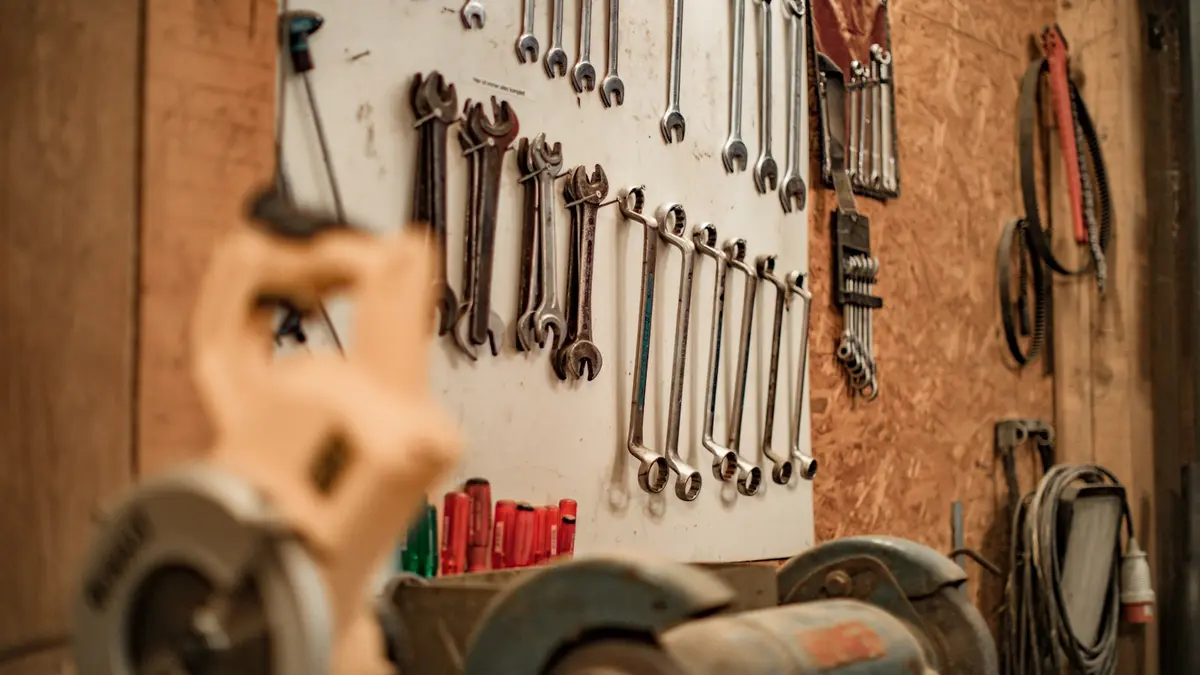
Source: Unsplash
This is also how to inventory replacement tools without buying duplicates. Your list should show not only what you lost, but why you owned it and when you last used it.
Build the replacement list around real jobs
Write down the next five to ten jobs you expect to do. Include routine repairs, seasonal tasks, vehicle work, moving, outdoor maintenance, and any project already underway.
For example, a homeowner’s list might include:
- Hang shelves and pictures.
- Tighten loose cabinet hardware.
- Assemble furniture.
- Shut off water and make a minor plumbing repair.
- Change a vehicle battery or replace wiper blades.
- Patch drywall.
- Cut lumber for a small repair.
- Maintain a mower, trimmer, or other yard equipment.
Then assign each missing tool one of four priorities:
Priority 1: Safety and immediate access
Buy or restore the items that let you work safely and handle minor emergencies. This usually includes eye protection, a good flashlight or work light, gloves appropriate to the task, a basic first-aid kit, a fire extinguisher appropriate for the space, and safe access to electrical shutoffs, water shutoffs, and the vehicle.
For electrical work areas such as garages, make sure the outlet protection is functional. The U.S. Consumer Product Safety Commission recommends GFCI protection in garages and notes that portable GFCIs can be as effective as installed units. CPSC home electrical safety checklist If the garage wiring was affected by fire or water, have it assessed before relying on it for tools or charging.
Priority 2: Core hand tools and measuring tools
These are the tools that solve a high number of ordinary home and car tasks at low cost and low storage burden. Replace these before buying large kits, duplicate sizes, or single-purpose power tools.
Priority 3: Task-specific power tools
Buy these only when a scheduled task cannot reasonably be done with the core kit, borrowed equipment, rental equipment, or a different method. A drill/driver may be a Priority 3 purchase for one homeowner but a Priority 1 work tool for someone repairing a damaged house.
Priority 4: Specialty, duplicate, and hobby tools
This includes tools that serve a narrow task, tools you used only occasionally, duplicates kept for convenience, and equipment for a hobby that is not currently active. Put these on a watch list rather than a shopping cart.
Replace a core kit before rebuilding a workshop
A core kit should cover fastening, gripping, measuring, light cutting, and basic maintenance. Choose individual pieces or a modest set based on the jobs you listed, rather than buying the largest preassembled kit available.
A practical first-wave kit often includes:
- Tape measure.
- Small torpedo level and, if you use it often, a longer level.
- Utility knife with replacement blades.
- Hammer.
- Screwdriver set or bit driver with common bits.
- Adjustable wrench.
- Tongue-and-groove pliers.
- Slip-joint or combination pliers.
- Needle-nose pliers.
- Locking pliers if you have recurring gripping or repair tasks.
- Hex key set in the sizes used by your furniture, bicycles, appliances, or vehicles.
- Socket set and ratchet in the drive size that matches your actual vehicle and repair needs.
- Combination wrenches in commonly used sizes.
- Small pry bar.
- Clamps suited to the work you do.
- A file, scraper, or sanding block for minor repair work.
Add a small assortment of fasteners, picture hangers, wall anchors, electrical tape, zip ties, pencils, and marking tools only after checking what survived. Consumables are easy to buy twice during the confusion of a loss.
Measuring tools deserve early priority because they prevent waste. A tape measure, level, straightedge, and marking tool can avoid incorrect cuts, misplaced holes, and a second trip for materials. If you work on cars, include tools that fit your vehicle’s fasteners rather than assuming a broad mechanics set is necessary immediately.
Buy power tools only when the next job creates a clear need
Once the core kit is in place, buy the power tools that remove a repeated bottleneck. For many households, the first is a drill/driver because it handles drilling, driving screws, assembly, and light repair work. But it should not automatically be your first purchase if your immediate needs are plumbing, hand-tool automotive work, or yard cleanup.
Use the job list to decide what comes next:
If your near-term work is fastening and assembly
Prioritize a drill/driver, drill bits suited to the materials you actually drill, driver bits, and a small selection of appropriate fasteners. Check the current tool manual for approved bit types, chuck capacity, battery use, and maintenance instructions.
If your near-term work is cutting sheet goods or framing lumber
Consider a circular saw only when you have a safe work surface, a way to support material, appropriate eye protection, and a clear need for repeated cuts. Do not treat a saw as a substitute for a cutting plan. You may need straightedge guides, clamps, and sawhorses before the saw itself becomes useful. For safe cutting practices, see how to cut plywood straight with a circular saw and how to prevent circular saw tear-out.
If your near-term work is repair, demolition, or trimming
A reciprocating saw or oscillating multi-tool may be justified, but only when its intended work is recurring. These tools are often purchased early because they seem versatile, then sit unused. Buy the tool after identifying the materials, blades, and access constraints of the actual repair.
If your near-term work is vehicle maintenance
Prioritize a correctly sized socket and wrench set, a torque wrench if your vehicle’s procedure requires one, a jack and stands only if you can follow the vehicle manufacturer’s lifting instructions, and task-specific items such as an oil-filter wrench when needed. Verify all torque values, lifting points, capacities, and service procedures in the current vehicle documentation. Do not guess at torque settings.
If your near-term work is yard maintenance
Replace the machine you need for the season first, then the supporting hand tools and consumables. A mower may matter before a cordless drill in spring; a pruning tool may matter before either. For a staged approach, see yard tools to buy first.
Avoid getting trapped in a battery platform too early
Replacing stolen or fire-damaged cordless tools can tempt you to buy a large bundle immediately. Slow down long enough to decide whether you actually need a shared battery platform and how many batteries you need for your normal work.
Choose a cordless system based on the tools you expect to add in the next year, not every category it offers. If you only need occasional drilling, one tool, one battery, and its specified charger may be enough. If you regularly use multiple cordless tools, a shared platform can reduce charger and battery duplication.
Do not mix batteries and chargers unless the tool manufacturer explicitly states they are compatible. CCOHS advises using only the battery specified for the tool and the charger intended for that battery. CCOHS electric-tool safety guidance
If any surviving batteries were exposed to fire, heat, water, impact, or corrosion, do not use them merely because they fit a new tool. Follow the manufacturer’s current inspection and disposal guidance.
Decide what not to replace yet
The fastest way to overspend while rebuilding a tool collection is replacing tools for imagined future projects. Put these items on a deferred list unless you have a dated need:
- Duplicate hammers, pliers, drivers, and tape measures.
- Large mechanic sets with sizes you do not use.
- Specialty saws and routers for one possible woodworking project.
- Welding, air-compressor, or pneumatic equipment without a current job and safe workspace.
- Large stationary woodworking machines.
- Niche automotive diagnostic equipment.
- Extra chargers and batteries beyond your working routine.
- Large storage systems before you know the size and shape of the rebuilt collection.
A good rule is: replace a specialty tool after you have identified the task, material, accessory, and safe setup required to use it. Until then, borrowing, renting, or hiring out one unusual job may cost less than ownership.
Rebuild storage after the first tool wave
Do not make tool storage the first major purchase unless you need a secure, dry way to keep replacement tools from being damaged or stolen. Start with simple, lockable, dry storage that lets you see what you own. A small toolbox, cabinet, or modular case system can be enough during the first stage.
As you rebuild, store tools by task rather than trying to recreate an old layout from memory. Keep measuring and marking tools together, fasteners together, automotive tools together, and power-tool accessories with their related tool where practical. Label bins and cases so you can find items before buying another one.
If theft was part of the loss, record serial numbers as tools are replaced. Photograph each purchase and store the record outside the garage, such as in a secure digital folder. This supports future claims and makes your inventory easier to update.
Use a simple replacement score before every purchase
For each missing tool, score it from 0 to 2 in these categories:
- Safety: Does it help you perform a needed task safely?
- Frequency: Will you use it several times this season or year?
- Job urgency: Is a planned repair waiting on it?
- Versatility: Can it handle multiple tasks?
- Cost avoidance: Will owning it avoid repeated rentals, delays, or paid service calls?
Tools with the highest totals belong in the next purchase wave. Tools with low totals stay on the list until a real project moves them up.
For example, a tape measure may score high for nearly every homeowner because it is inexpensive, widely useful, and needed before many repairs. A specialty joinery tool may score low unless you are actively rebuilding cabinetry or returning to a specific woodworking project.
Inspect every replacement before use
A new purchase is not automatically ready for work. Read the manual, confirm the included accessories are correct, and inspect the tool before first use and before later use. General safety guidance calls for removing damaged tools from service, using tools only for their intended purpose, and following manufacturer instructions. University of Maryland Eastern Shore EHS
For corded tools, inspect the cord, plug, housing, switch, and guards. Do not use a cord with cuts or fraying; University of Tennessee safety guidance says damaged cords require the equipment to be removed from service immediately. Hand and portable power tool safety guidelines
For cutting, drilling, grinding, or sanding tools, verify in the current manufacturer documentation that the blade, bit, wheel, or accessory is approved for that tool and the intended material. Also verify required guards, speed limits, mounting procedures, and personal protective equipment. Do not rely on an accessory fitting physically as proof that it is safe to use.
A sensible order for most homeowners
If you need a quick starting sequence, use this order and adjust it to your actual projects:
- Make the garage and electrical supply safe; document the loss.
- Replace basic PPE, lighting, first-aid supplies, and emergency access items.
- Replace measuring, marking, fastening, gripping, and basic cutting hand tools.
- Replace the vehicle or yard tools needed for current maintenance.
- Add the first power tool only when a scheduled project requires it.
- Add accessories, consumables, and storage that support the tools already in use.
- Replace specialty and hobby equipment one project at a time.
Rebuilding a tool collection is not about getting back to the number of tools you once owned. It is about restoring the ability to handle your normal work safely, without filling the garage with costly duplicates and equipment that has no current job.
References
- CCOHS: Powered Hand Tools - Electric Tools - Basic Safety. (n.d.). https://www.ccohs.ca/oshanswers/safety_haz/power_tools/saf_elec.html
- Hand and Power Tool Safety | Environmental Health and Safety. (n.d.). https://wwwcp.umes.edu/ehs/hand-and-power-tool-safety
- How to Build a Hand and Power Tool Safety Policy. (n.d.). https://www.smarterrisk.com/blog/hand-and-power-tool-safety
- [PDF] HAND AND PORTABLE POWER TOOL SAFETY GUIDELINES. (n.d.). https://ehs.utk.edu/wp-content/uploads/2017/02/HandAndPowerToolGuidelines-032415.pdf
- Power tools inspection and maintenance checklist. (n.d.). https://www.facebook.com/groups/727778230700993/posts/3328943857251071
- Hand and Power Tools — OSHA 3080 Revisited. (n.d.). https://iaeimagazine.org/electrical-fundamentals/hand-and-power-tools-osha-3080-revisited
- Henderson Fire Department. (n.d.). https://www.facebook.com/hendersonfiredepartment/posts/henderson-fire-department-has-responded-to-an-increase-in-garage-fires-and-there/1400821005567690
- HOME ELECTRICALSafety Checklist. (n.d.). https://www.cpsc.gov/s3fs-public/513.pdf
- Battery-Powered Tools Provide Greater Safety on the Job. (n.d.). https://weeklysafety.com/blog/battery-powered-tools
- Emerging Risks of Lithium-Ion Battery Powered Hand Tools. (n.d.). https://www.prismrisk.gov/member-services/guidance-and-resource-library/risk-simplified/prism-risk-simplified/emerging-risks-of-lithium-ion-battery-powered-hand-tools
 Corded vs. Cordless Power Tools When Your Garage Has No Power
 What Tools Do You Need to Start Woodworking? A Project-First Starter Kit
 Can You Use a Circular Saw or Router Upside Down?