Kickback happens when a spinning wheel catches, binds, or is pinched in the metal, causing the grinder to jerk suddenly. To reduce the risk, use the correct undamaged cutoff wheel and guard, clamp the work securely, support it so the cut stays open, hold the grinder with both hands, and cut with light, straight pressure. Do not twist a cutoff wheel, side-load it, or force it through a cut.
For a beginner, the key is not trying to overpower the grinder. Set up the work so the wheel can make a straight, relaxed cut. If the tool starts bogging down, the kerf closes, the work moves, or you must push hard, stop immediately rather than trying to finish the cut.
Understand what causes angle grinder kickback
An abrasive cutoff wheel removes material at high speed. If the wheel becomes trapped by a closing kerf, catches an edge, or is twisted sideways in the slot, it can stop or grab abruptly. The grinder can then move unexpectedly in reaction to that bind. A secure grip and safe body position help you control that reaction, but preventing the bind is the first priority.
Common kickback triggers include:
- A workpiece that shifts because it was held by hand or poorly clamped.
- A cut that closes and pinches the wheel as the metal sags or moves.
- Twisting the grinder to widen, steer, or pry open a cut.
- Applying heavy pressure instead of letting the wheel cut.
- Using a damaged, incorrect, or improperly mounted wheel.
- Using a cutoff wheel for side grinding.
Cornell’s safety guidance specifically advises minimum pressure to prevent the disc from digging in and causing kickback, as well as firm work holding where appropriate. Cornell Environment, Health and Safety
Choose and inspect the wheel before cutting
Use a wheel specifically intended for cutting the metal in question and approved for use on your grinder. A cutoff wheel is not a grinding wheel: it is made to cut on its edge and should not be used for side grinding, blending, or levering a cut open. OSHA and Cornell both identify correct disc selection, correct mounting components, and matching speed ratings as basic safety requirements. OSHA angle grinder safety guidance Cornell Environment, Health and Safety
Before mounting a wheel:
- Read the grinder manual and the wheel label. Verify that the wheel type, diameter, arbor arrangement, and mounting hardware are approved for your tool.
- Confirm that the wheel’s maximum RPM rating is at least as high as the grinder’s maximum rated speed. Do not guess from wheel size or appearance.
- Reject a wheel that is cracked, chipped, wet-damaged, dropped, or otherwise questionable.
- Use the flanges and locking nut specified for that wheel type. Do not modify the arbor hole or force a wheel onto the tool.
- Disconnect the corded grinder from power, or remove the battery from a cordless grinder, before changing accessories.
Keep the wheel guard installed. Position it according to the grinder and wheel manufacturer’s instructions so it helps deflect debris away from you and exposes the minimum practical amount of wheel on your side. Do not remove or rotate the guard out of the way to reach an awkward cut. The Fabricator
Set up the workpiece so the kerf cannot pinch
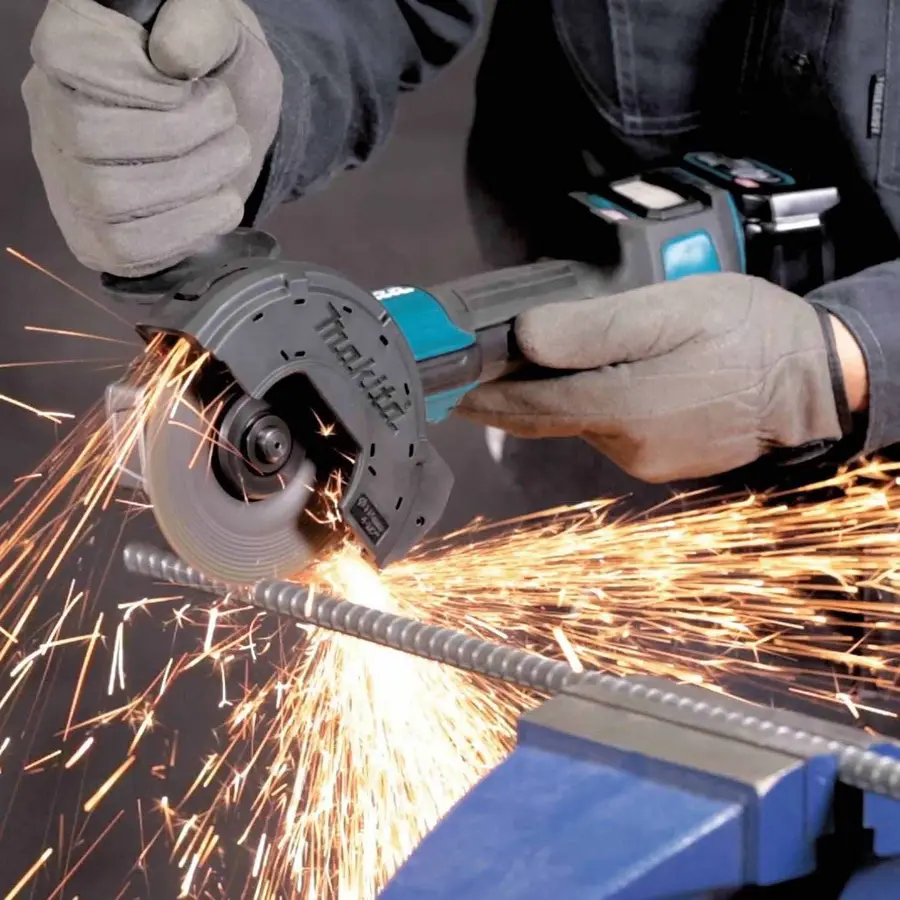
Workpiece positioning has a major effect on kickback. Metal that can roll, vibrate, sag, or spring during the cut can trap the wheel. Clamp small stock in a bench vise when possible. For long stock, use stable supports in addition to clamping so the piece does not shift or drop unexpectedly.
Before turning on the grinder, think through what will happen when the cut is nearly complete. The two parts must remain stable, and the cut slot—called the kerf—must not close on the wheel. Adjust the clamp and support locations if the material’s weight would make either side sag into the cut.
A useful setup check is a dry run with the grinder unplugged or battery removed:
- Place the work at a comfortable height, ideally around waist level rather than on the floor.
- Clamp the main workpiece firmly enough that it cannot rotate or vibrate.
- Support the offcut if it is long or heavy, but do not create a support arrangement that pushes the cut closed as the material separates.
- Trace the intended cut with the tool held clear of the metal. Confirm that the wheel will not hit a vise jaw, clamp, support, or hidden fastener.
- Ensure the power cord, battery area, and your footing will remain clear of the wheel and sparks.
If you cannot arrange stable support and a clear cutting path, do not improvise by holding the metal with a boot or one hand. Change the setup, use a different cutting method, or get help supporting the work. Properly securing the workpiece is specifically identified in OSHA’s grinder safety guidance. OSHA angle grinder safety guidance
Use a controlled angle grinder cutting technique
Install the auxiliary handle and hold the grinder with both hands: one hand on the main body and one on the side handle. Keep a firm grip without locking your elbows. Your arms should have room to resist movement if the wheel catches.
Stand balanced with both feet planted. Do not stand directly in the grinder’s likely path if it jumps or pulls during a bind. Keep your face and torso out of the line of the wheel, and position yourself so you do not need to reach, lean, or cut between your feet. Guidance for grinder users emphasizes proper footing, balance, a firm grip, and body positioning that can resist kickback forces. The Fabricator
Start the grinder clear of the work and let it reach operating speed. Then bring the wheel into the marked line gently. Keep the wheel square to the cut and advance with light, steady pressure. A cutoff wheel should stay aligned with the slot from the beginning of the cut to the end.
Do not use the side of the wheel to correct direction. If the cut wanders, stop, let the wheel come to a complete stop, and reassess the line and work support. Twisting or side-loading a cutoff wheel can cause binding and can damage the wheel. Zoro Resource Hub
Know the wheel contact zone
Wheel rotation direction and the guarded side of the tool affect where the grinder may move if the wheel grabs. Do not rely on a generic online diagram for this: grinders differ in handle placement, guard design, and approved accessory configurations. Check the direction-of-rotation marking on the tool and follow the current manual’s instructions for the approved cutting position and guard orientation.
The practical rule is consistent: keep your body out of the possible movement path, keep the guard between you and the wheel where the manufacturer directs, and avoid bringing the wheel into contact in a way that could make it climb, snag, or be pulled into an edge. If you cannot identify a safe approach because of the shape or orientation of the metal, reposition the work rather than cutting from an awkward angle.
Stop when the cut begins to bind
Do not try to power through a binding cut. The warning signs are usually clear: the grinder slows sharply, the wheel squeals, the metal shifts, the kerf visibly narrows, sparks change abruptly, or you feel the tool being pulled sideways.
When that happens:
- Release the trigger while maintaining both-hand control.
- Hold the grinder securely until the wheel stops completely.
- Do not pull or twist a moving wheel out of the kerf.
- Disconnect power or remove the battery before inspecting the setup.
- Check the wheel for damage and replace it if there is any doubt.
- Re-clamp and re-support the metal so the kerf stays open, then restart only if the setup is stable.
Forcing a cutoff wheel through resistance increases the chance of binding and kickback. A damaged or dropped abrasive wheel should not be returned to service. Cornell Environment, Health and Safety
Wear protection and control the work area
Eye and face protection, hearing protection, and suitable clothing are part of the setup, not an optional extra. OSHA’s grinder guidance calls for appropriate PPE and notes hazards including flying particles, sparks, noise, dust or fumes, cuts, and fire. OSHA angle grinder safety guidance
For metal cutting, use safety glasses plus a face shield, hearing protection, and close-fitting clothing without loose strings or jewelry. Wear gloves only if they are appropriate for the task and do not compromise your grip or create an entanglement risk; follow the grinder manufacturer’s PPE guidance and workplace rules. Use respiratory protection when the material, coating, dust, or work environment requires it.
Direct sparks away from yourself, other people, flammable materials, fuel containers, and combustible dust. Keep bystanders out of the spark and debris area. Do not use an angle grinder where sparks could ignite vapors or other flammables unless the site has been assessed and the required controls are in place.
Quick pre-cut checklist
Before every metal cut, confirm:
- The grinder, guard, side handle, wheel, flanges, and locking nut are in good condition.
- The wheel is the correct type for cutting and is rated for at least the grinder’s maximum RPM.
- The guard is secure and positioned according to the manual.
- The workpiece is clamped and supported so it cannot move or pinch the wheel.
- The cut path is clear of clamps, vise jaws, cords, and your body.
- You can use a two-hand grip with stable footing and no overreaching.
- Sparks have a safe direction and flammables are cleared from the area.
- You will stop—not force the tool—if the wheel begins to bind.
A slower, well-supported cut is safer than a fast cut made with extra pressure. The best way to prevent angle grinder kickback is to make binding unlikely before the wheel ever touches the metal.
References
- Essential Angle Grinder Safety Tips for DIY and Professionals. (n.d.). https://safatcotrading.com/essential-angle-grinder-safety-tips-for-diy-and-professionals
- Cutting and grinding safety. (n.d.). https://www.thefabricator.com/thefabricator/article/finishing/cutting-and-grinding-safety
- Angle Grinder Safety: How to Use an Angle Grinder Safely. (n.d.). https://www.zoro.com/resourcehub/angle-grinder-safety
- What Is Angle Grinder Kickback? Causes And Response. (n.d.). https://garagewelding.com/what-is-kickback-on-an-angle-grinder-causes-prevention
- Angle Grinder Toolbox Talk | Environment, Health and Safety. (n.d.). https://ehs.cornell.edu/campus-health-safety/occupational-safety/tool-and-machine-safety/angle-grinder-toolbox-talk
- How to Avoid Angle Grinder Kickback? – Stay Safe Now. (n.d.). https://toolsadvisers.com/how-to-avoid-angle-grinder-kickback
- Grinder safety practices to prevent injuries. (n.d.). https://www.facebook.com/groups/209829190372971/posts/1420515885970956
- Portable Cutoff Wheel Safety - Do’s, Don’ts, and Safe Practices - Empire Abrasives. (n.d.). https://www.empireabrasives.com/blog/portable-cutoff-wheel-safety-dos-donts-safe-practices
- Safety Guide Grinding Wheel Users. (n.d.). https://pacergrindingwheels.com/wp-content/uploads/2023/06/Safety-Guide-for-Grinding-Wheels-1.pdf
- Angle Grinder Safety. (n.d.). https://www.osha.gov/sites/default/files/2018-12/fy15_sh-27664-sh5_Toolbox_Angle_Grinder.pdf
 Can You Put a Circular Saw Blade on an Angle Grinder?
 How to Prevent Table Saw Kickback When Ripping Panels
 How to Cut an Electrical Box Opening in Cinder Block