A wide board can be cut accurately on a table saw only when it is fully supported and guided by the right accessory for the cut. Use the rip fence for a rip cut, where the board moves lengthwise through the blade. Use a miter gauge or crosscut sled for a crosscut, where the board moves across the blade. Do not hold a wide board against both a miter gauge and a fixed rip fence during the cut; the offcut can bind between the fence and blade.
If the board is too long, too heavy, or too wide to remain flat and controlled through the entire cut, do not force the table-saw setup. A track saw, circular saw with a straightedge, or a panel-cutting setup is often the safer and more accurate choice for large stock.
Start by identifying the cut
A clean result starts with matching the setup to the grain direction and the board’s size.
Rip cut: cutting with the grain
A rip reduces the board’s width. The long edge runs against the rip fence while the workpiece travels parallel to the blade. This is the normal table-saw job, provided the board can stay supported on the table, alongside it, and after it passes the blade.
For a wide rip, support matters more than hand pressure. If the board droops or twists as it enters or leaves the blade, it can wander away from the fence, pinch the blade, or leave a rough edge.
Crosscut: cutting across the grain
A crosscut shortens the board. The board should be carried by a miter gauge or a crosscut sled, with its reference edge held firmly against that guide’s fence.
Move the rip fence out of the cutting area for ordinary crosscuts. The Canadian Centre for Occupational Health and Safety specifically advises removing the rip fence when crosscutting and not using it as a cutoff gauge. It also calls for adequate support at the rear and sides of the saw table for wide or long stock. CCOHS table-saw guidance
Why wide boards tear out and cut inaccurately
Wide stock is difficult because more of its weight sits away from the saw table and away from your controlling hand. A board that rocks, sags, or shifts can change its relationship to the blade during the cut.
Tear-out is usually most visible where the blade exits the wood fibers. It is made worse by a dull or damaged blade, poor workpiece support, a board that shifts during the cut, or an unsuitable blade for the operation. OSHA advises using the proper blade for the cutting action and keeping blades sharp; cracked blades should be removed from service. OSHA table-saw safety guidance
Accuracy problems usually come from one of four causes:
- The board is not supported level with the saw table.
- The fence, miter gauge, or sled is not square to the blade.
- The board moves away from its guide during the cut.
- The cut closes on the blade because of internal wood stress or a warped board.
Correct the setup before trying to correct the cut with extra force. Pushing harder does not make an unstable board cut straighter.
Set up the saw before cutting
Check the board first
Choose a reasonably flat reference face to ride on the saw table and a straight reference edge for the fence or sled. A twisted, cupped, or bowed board may not register reliably against a straight fence.
Mark the cut line and decide which side is the keeper. When appearance matters, plan so any minor exit-side tear-out lands on the waste piece or on a face that will be hidden.
Inspect the blade and cutting path
Use a clean, sharp blade appropriate for the operation and material. Verify that the blade is properly installed and that the blade height, guard, riving knife or splitter, and other parts are configured as the saw manufacturer directs for the cut you are making.
Keep the table and fence clear of offcuts, clamps, measuring tools, and debris. Make sure there is clear space before, beside, and behind the saw.
Add support before the board reaches the blade
Set support so the board stays level from the beginning of the cut through the end. For a wide rip, that may mean an extension wing, a side support table, and an outfeed table. For a long crosscut, support the overhanging portion without allowing the support to steer or lift the board.
OSHA says to support all pieces of stock, including the cut and uncut ends, scrap, and finished product. CCOHS likewise recommends extension tables or roller supports for larger pieces. OSHA table-saw safety guidance CCOHS table-saw guidance
Avoid using a helper as a substitute for a proper outfeed setup. If someone assists, they should support the board only after it reaches the outfeed support and should not pull it through the blade. CCOHS notes that an assistant should stand to one side and wait until the work reaches the extension table. CCOHS table-saw guidance
How to crosscut a wide board accurately
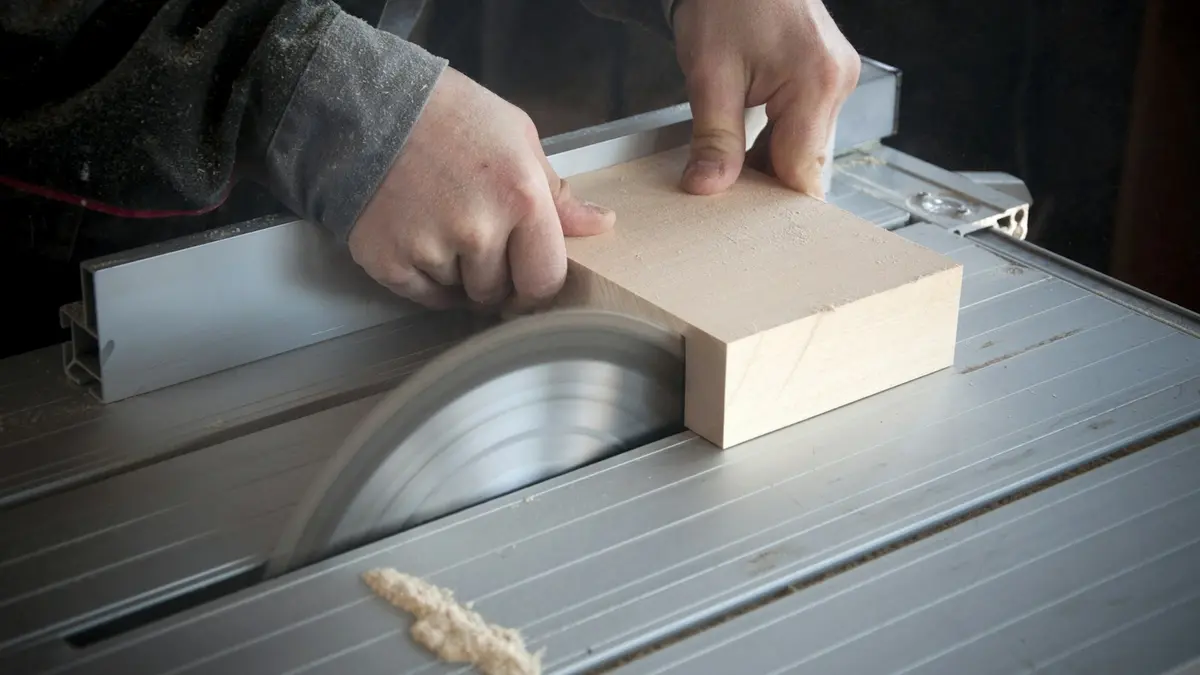
A crosscut sled is usually the best table-saw accessory for a wide board because it supports the workpiece across a broad area and keeps it square to the blade. A properly adjusted miter gauge with an auxiliary fence can work for narrower pieces, but a wide board can overwhelm a small miter gauge.
1. Confirm the sled or miter gauge is square
Check that the guide fence is square to the blade. Make a test cut in scrap and verify it before cutting the finished board. If repeated pieces must match, use a stop block on the sled or an appropriate stop system that does not leave the workpiece trapped between a fixed fence and the blade.
2. Position the board securely
Place the board flat on the sled or saw table, with its reference edge firmly against the sled fence or miter-gauge fence. Keep the board from rotating as the blade enters it. If the board is awkward to hold safely, use a larger sled, clamps designed for the sled, or choose another cutting method.
3. Keep the rip fence clear
Do not use the rip fence as a fixed length stop for a through crosscut. The space between a fixed fence and a spinning blade can trap the cutoff, increasing the chance of binding or kickback. CCOHS explicitly says never to use the rip fence as a cutoff gauge. CCOHS table-saw guidance
4. Make one smooth cut
Stand to one side of the blade’s potential kickback path. Start the saw, let it reach normal operating condition as directed in its manual, and move the sled or miter gauge steadily through the blade. Keep the board against the guide fence throughout the cut.
Continue past the blade until the cut is complete, then stop feeding. Do not reach near the blade or retrieve offcuts until the blade has stopped. OSHA and CCOHS both advise positioning the body to one side of the blade rather than directly behind it. OSHA table-saw safety guidance CCOHS table-saw guidance
How to rip a wide board cleanly
For a rip, the rip fence establishes the finished width. Your job is to keep the board’s reference edge in consistent contact with the fence while maintaining flat support on the table.
1. Set the fence and verify the measurement
Set the fence to the desired finished width and measure at the blade area and farther along the fence if your saw setup allows. Confirm that the fence locks securely and does not shift when pressure is applied.
2. Support the board on all three sides
The infeed side, side of the saw, and outfeed side should support the board without forcing it toward or away from the fence.
Roller stands can help carry weight, but they must be positioned carefully. A support set too high can lift the board; one set too low allows sag. For very broad panels, a solid, level extension surface is generally easier to control than a single roller support.
3. Feed straight, not sideways
Keep the board against the fence while feeding it forward at a controlled, even pace. Do not twist the board into the blade to correct a wandering cut. If the board starts to bind, stop the feed, turn the saw off if necessary, and reassess the setup after the blade stops.
Use the riving knife, splitter, blade guard, anti-kickback devices, and push aids as directed by the current manual for your saw and the operation. CCOHS recommends using a guard with a spreader or riving knife and anti-kickback fingers for ripping or crosscutting operations. CCOHS table-saw guidance
4. Plan for the final portion of the cut
As your hands approach the blade area, use an appropriate push stick or push block rather than reaching forward with bare hands. CCOHS advises push-stick use for narrow or short stock and directs operators to follow the manufacturer’s instructions for ripping applications. CCOHS table-saw guidance
Keep pushing until the workpiece is fully past the blade and supported by the outfeed surface. Do not pull the board from the back of the saw while the blade is running.
Reduce tear-out before and after the cut
A better setup prevents most tear-out, but these steps can improve the edge further.
Use a sharp, suitable blade
A blade that is dull, dirty, damaged, or wrong for the cut tends to leave a rougher edge and demands more feed pressure. Select a blade intended for the operation, following the saw and blade manufacturers’ current instructions. OSHA specifically warns against using a crosscut blade for ripping. OSHA table-saw safety guidance
Support fibers at the cut line
For veneered plywood, melamine, or other fragile-faced sheet goods, a zero-clearance insert or a sacrificial backer can support fibers near the blade exit. Verify that any insert, sled, backer, or fixture is compatible with your specific saw, blade, and guard or riving-knife arrangement before use.
Use a scoring pass only when it is controlled
For some sheet goods, a shallow first pass followed by a full-depth pass can reduce breakout on one face. This adds complexity and is not a substitute for stable support. Do not use a partial-cut method unless the workpiece can remain controlled and the method is allowed by the saw manufacturer.
Clean up only a small amount
If the cut must be furniture-grade, leave a small amount of waste and make the final edge with a jointer, router and straightedge, hand plane, or sanding block. Do not try to correct a badly wandering table-saw cut by forcing the board back into the blade.
When not to use the table saw
Choose another method when the board cannot be supported and controlled without awkward reaching, excessive lifting, or a helper pulling from the outfeed side.
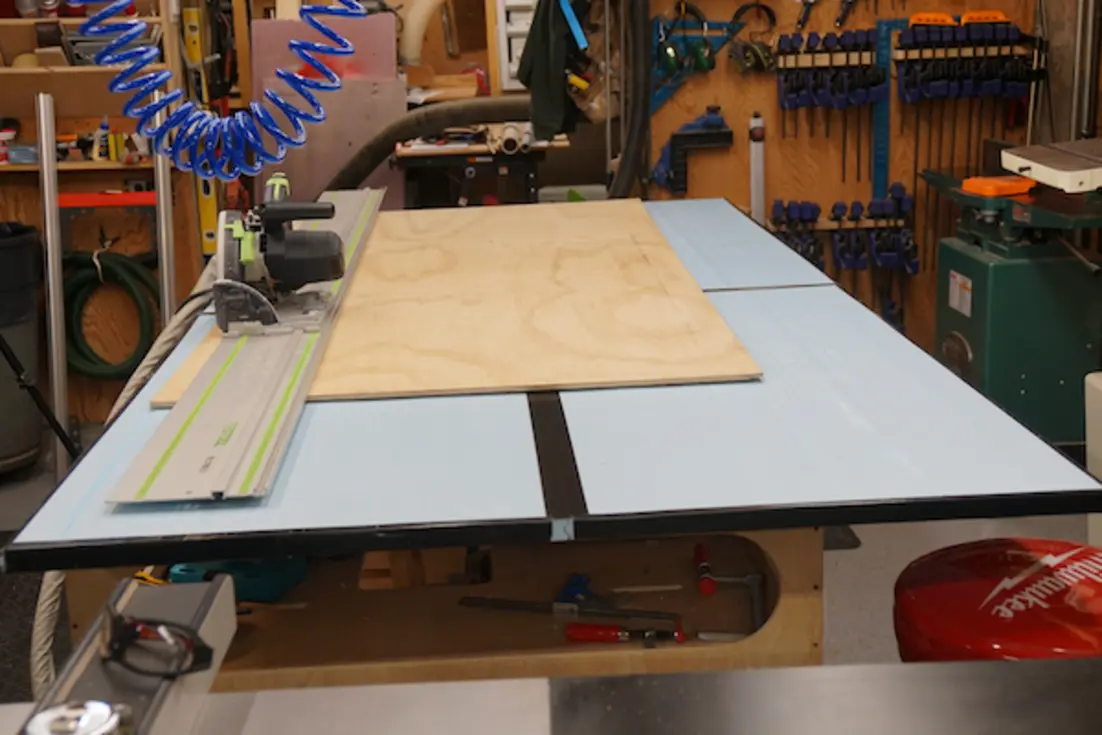
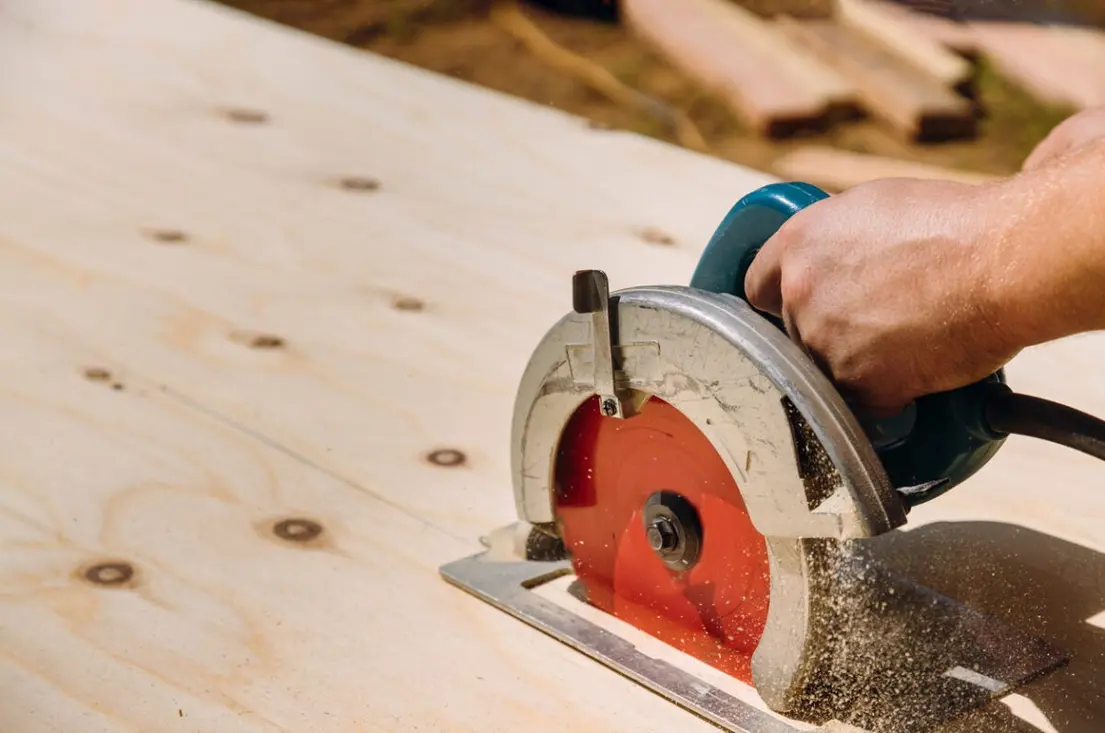
A track saw is well suited to large panels because the material can stay supported on a work surface while the saw moves. A circular saw with a straightedge can do the same job when used with a stable support arrangement that protects the blade path and prevents the cutoff from pinching the blade. For a board that needs a precise final edge, make the guided rough cut slightly proud and finish the edge with a router or hand plane.
A miter saw may be appropriate for boards that fit flat against its fence and table, but do not place a board sideways or use a setup the saw manufacturer does not approve. For long boards, support both sides so the stock remains level with the saw table.
Quick decision guide
Use a table saw when:
- The board can stay flat and supported before, during, and after the cut.
- You have a stable crosscut sled or miter-gauge setup for a crosscut.
- You have a straight fence, adequate side support, and outfeed support for a rip.
- You can keep your hands clear of the blade and remain out of the kickback path.
Use a track saw or guided circular saw when:
- The board is too large to control comfortably on the table saw.
- The cut is across a long, heavy board.
- Supporting the board would require reaching across the blade or relying on someone to pull the stock.
- The panel is easier to keep stationary than to move through a saw.
The cleanest and safest wide-board cut is the one that keeps the workpiece stable from start to finish. If you cannot provide that stability at the table saw, change the setup or use a different tool rather than trying to compensate with force.
References
- eTool : Machine Guarding - Saws - Table Saws | Occupational Safety and Health Administration. (n.d.). http://www.osha.gov/etools/machine-guarding/saws/table
- Table Saw Basics - How To Crosscut. (n.d.). https://www.youtube.com/watch?v=XsmAxJ7Qc6M
- How can I accurately cross-cut a board that is too wide for …. (n.d.). https://woodworking.stackexchange.com/questions/4948/how-can-i-accurately-cross-cut-a-board-that-is-too-wide-for-my-table-saw
- CCOHS: Woodworking Machines - Table Saws. (n.d.). https://www.ccohs.ca/oshanswers/safety_haz/woodwork/tbl_saw.html
- 99% of Beginner’s Don’t Know These Table Saw Mistakes to Avoid!. (n.d.). https://www.youtube.com/watch?v=LLvXrmLLvKs
- Cutting It Close Safely - FineWoodworking. (n.d.). https://www.finewoodworking.com/project-guides/shop-machines/cutting-it-close-safely-on-the-tablesaw
- How to safely cross-cut on a table saw?. (n.d.). https://www.facebook.com/groups/woodworkingforbeginner/posts/3080708422083762
- Cutting wide board on table saw : r/BeginnerWoodWorking. (n.d.). https://www.reddit.com/r/BeginnerWoodWorking/comments/18k3tb6/cutting_wide_board_on_table_saw
- How to safely cut short boards on a table saw. (n.d.). https://www.facebook.com/groups/woodworkingforbeginner/posts/3142884645866139
- AlternativeTo - Crowdsourced software recommendations. (n.d.). https://alternativeto.net
 Track Saw vs. Table Saw: Which One Fits Your Cutting Work?
 Why a Circular Saw Blade Deflects During a Cut and How to Troubleshoot It
 Circular Saw vs. Miter Saw vs. Router: Which Tool Fits the Cut You Need?