A table saw blade should match the cut you make most often. Choose a dedicated rip blade for repeated long cuts with the grain in solid hardwood, a fine-tooth plywood or finish blade for veneered panels and clean crosscuts, or a 40- to 50-tooth combination or general-purpose blade if you need one blade for mixed beginner projects.
Do not assume the blade included with a new saw is wrong, but do not assume it is ideal either. Inspect its markings, condition, tooth count, and intended use. If it cuts reasonably cleanly without excessive effort, burning, or tear-out, it may be adequate for general work. Upgrade when your typical material or finish expectations call for a more specialized blade.
Start With the Material and Cut Direction
The most useful question is not “What is the best table saw blade?” It is: “What material am I cutting, and am I cutting with or across the grain?”
Ripping Hardwood
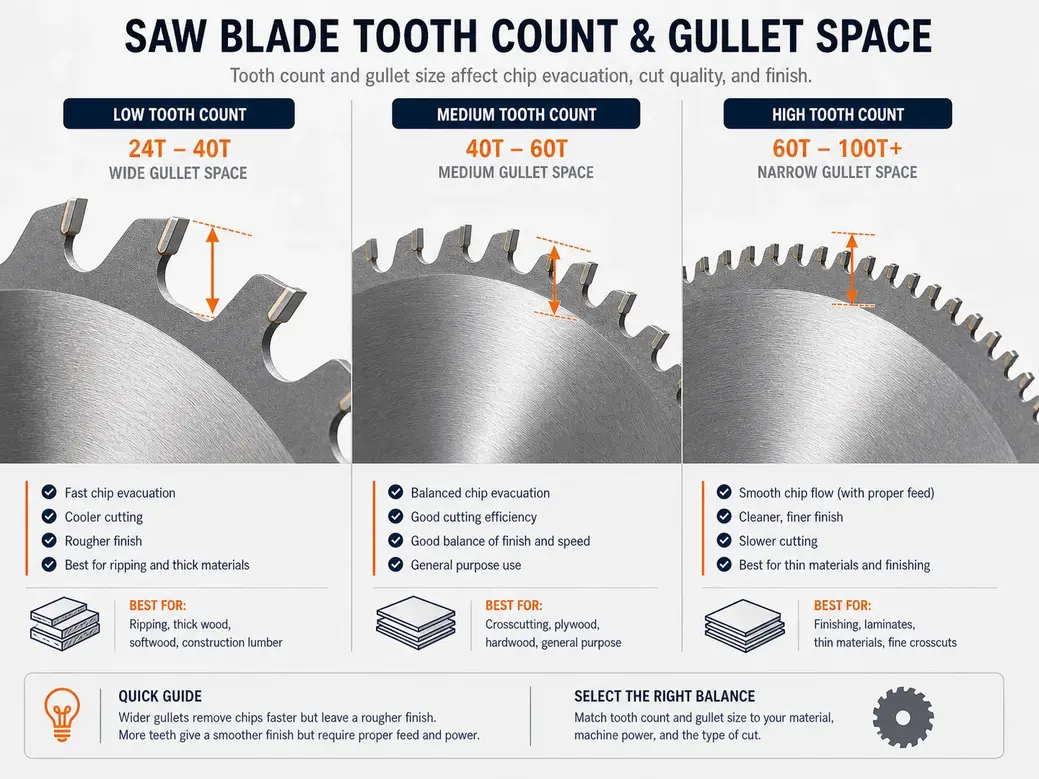
Ripping means cutting parallel to the grain of solid lumber. Hardwood produces substantial chips and can make a saw work hard, especially on thicker stock. A dedicated rip blade usually has relatively few teeth, often around 24 teeth on a common table-saw blade size, along with deep gullets between teeth.
Large gullets give chips somewhere to go. That supports a steadier feed and helps reduce heat buildup during long rips. A rip blade is usually the right choice when you regularly break down hardwood boards into narrower strips or mill a large amount of solid lumber.
The trade-off is edge quality. A rip blade can leave a surface that needs jointing, planing, or sanding before a show-quality glue-up or finish. That is normal; its priority is efficient material removal rather than a polished cut.
Crosscutting Solid Wood
Crosscutting means cutting across the grain. A crosscut or finish blade generally has more teeth than a rip blade, producing a smaller bite per tooth and a cleaner edge. It is useful for visible hardwood parts, trim pieces, miters, and cuts where a clean edge saves sanding.
A blade with roughly 60 to 80 teeth is commonly used for fine crosscuts and finish work. More teeth are not automatically better, however. A high-tooth-count blade can cut slowly in thick stock and may generate heat if pushed too hard.
Cutting Plywood and Veneered Panels
For cabinet plywood, veneered plywood, and similar sheet goods, use a blade intended for plywood, panels, or fine finish cutting. These blades typically have many teeth and a tooth geometry designed to score fragile face veneers rather than tear them away.
A 60- to 80-tooth blade is a common starting range for plywood work, but confirm that the blade listing specifically supports the panel material you are using. Coated panels, laminates, melamine, MDF, and veneer-core plywood can require different tooth geometry even when they look similar.
A plywood blade can leave noticeably cleaner edges on the top face of a panel, but blade choice is only part of the result. Proper support, a steady feed rate, fence alignment, and a sharp, clean blade also matter.
Mixed Beginner Projects
For a new table-saw owner making shelves, utility furniture, simple hardwood parts, and occasional plywood cuts, a combination or general-purpose blade is usually the sensible first replacement.
Look for a blade in the 40- to 50-tooth range that is listed for both ripping and crosscutting wood. It will not clear chips as aggressively as a dedicated rip blade or leave quite as refined a surface as a dedicated finish blade. In exchange, it avoids frequent blade changes and handles a wide range of ordinary work well.
Rip Blade vs. Crosscut Blade vs. Combination Blade
Rip Blade
Choose a rip blade when efficient hardwood ripping is the priority.
Typical traits include:
- Lower tooth count
- Large gullets for chip clearance
- Fast cutting along the grain
- A cut surface that may need cleanup
A rip blade is especially useful if a combination blade makes your saw bog down, leaves burn marks, or requires an uncomfortably slow feed during repeated hardwood rips.
Crosscut or Finish Blade
Choose a crosscut blade when clean edges across wood grain are the priority.
Typical traits include:
- Higher tooth count
- Smaller gullets
- Cleaner cuts in hardwood parts and plywood
- Slower cutting in thick solid wood
Use this type for finish-sensitive work rather than expecting it to be the best choice for long, heavy rips in thick hardwood.
Combination or General-Purpose Blade
Choose a combination or general-purpose blade when you alternate between ripping and crosscutting and prefer one blade to stay on the saw.
The names are sometimes used loosely. A traditional combination blade may use a repeating tooth pattern that includes chip-clearing teeth, while a general-purpose blade may use similarly shaped teeth throughout. What matters is the manufacturer’s stated application, tooth geometry, and material suitability—not the label alone.
How Tooth Count Affects the Cut
Tooth count is a useful shortcut, but it is not a complete buying specification.
- Fewer teeth generally mean faster cutting and better chip clearance in solid wood.
- More teeth generally mean a smoother edge and less tear-out in plywood and crosscuts.
- Middle-range tooth counts balance speed and finish for general work.
Also consider material thickness. A very fine blade can be a poor match for thick hardwood because more teeth engage the wood at once, increasing cutting resistance and heat. Conversely, a coarse rip blade may chip thin veneer because its teeth take larger bites.
Do not treat tooth count as a quality grade. Two blades with the same number of teeth can perform differently because of tooth shape, carbide quality, plate stiffness, kerf, and the materials they are designed to cut.
Understand Tooth Grind and Hook Angle
Blade labels may list tooth grind and hook angle. These details help explain why blades intended for different jobs behave differently.
Tooth Grind
A flat-top grind is common on rip-oriented blades. Its teeth act efficiently like small chisels, making it well suited to cutting with the grain and clearing chips.
An alternate top bevel, often abbreviated ATB, uses teeth beveled in alternating directions. The alternating points score wood fibers cleanly and are common on crosscut and general-purpose blades.
Some blades use a more specialized grind for laminate, melamine, or other panel products. If you are cutting coated sheet goods, select a blade explicitly rated for that material rather than relying on tooth count alone.
Hook Angle
Hook angle describes the direction the teeth lean relative to the blade. It affects how assertively a blade pulls into the material and how it cuts. Because appropriate hook angle depends on the blade design, material, saw type, and operation, use the blade maker’s intended-use guidance instead of choosing solely by this specification.
For a typical table-saw owner, it is enough to know that tooth count, tooth grind, and hook angle work together. A blade designed as a system for plywood cutting is a more dependable choice than a random high-tooth-count blade.
Choose the Right Kerf for Your Saw
Kerf is the width of material removed by the blade. Full-kerf blades remove more material, while thin-kerf blades remove less.
A thin-kerf blade can reduce the load on a lower-powered or portable table saw because it cuts a narrower slot. It can be a practical choice for hardwood ripping on a smaller saw. A full-kerf blade may offer more stiffness, but it requires more power to push through dense stock.
Do not choose kerf based on power alone. Check the saw manual for any blade-thickness, riving-knife, guard, and accessory limitations. The riving knife must be compatible with the blade kerf and plate thickness; verify the current saw manufacturer’s instructions before changing blade types.
Confirm Diameter, Arbor, and Speed Rating Before Buying
Never assume a blade fits because it looks like the correct size. Before purchase, check the saw manual and the blade markings for:
- Permitted blade diameter
- Arbor-hole size and any approved arbor configuration
- Blade speed rating compared with the saw’s no-load speed
- Permitted blade kerf and body thickness
- Whether the blade is approved for the material and operation
- Any restrictions involving the guard, riving knife, dado accessories, or specialty blades
Use only an undamaged blade with readable markings that is suitable for the saw and operation. Follow the current manufacturer instructions for installation, inspection, guarding, and adjustment. If the fit is uncertain, stop and confirm with the saw and blade manufacturers rather than modifying a blade or forcing an incompatible accessory onto the arbor.
A Simple Blade Choice for Common Jobs
If You Mostly Rip Hardwood
Buy a dedicated rip blade, particularly if you repeatedly cut hardwood boards to width. Keep a combination blade available for general work if you do not want to use the rip blade for every crosscut.
If You Mostly Build Plywood Cabinets or Shelves
Buy a fine plywood or finish-cut blade rated for veneered panels. It is the better choice when exposed plywood edges, cabinet parts, and clean veneer faces matter more than maximum ripping speed.
If You Do a Little of Everything
Start with a 40- to 50-tooth combination or general-purpose blade rated for wood. It is the most flexible option for basic furniture, utility projects, construction lumber, occasional hardwood, and moderate plywood work.
If You Want the Cleanest Finish on Hardwood Parts
Use a dedicated crosscut or finish blade for visible crosscuts and a rip blade for heavy ripping. This two-blade setup is more specialized, but it separates fast stock preparation from finish-quality cutting.
Poor Cuts Do Not Always Mean You Need a New Blade
A new blade will not fix every cutting problem. Check the blade and saw setup before replacing anything.
Burning or Smoke
Burn marks can result from a dull or dirty blade, a blade inappropriate for the cut, slow feeding that lets the blade rub, or misalignment between the blade and fence. Resin and pitch buildup can make a blade cut hotter even when its teeth are still sharp.
Disconnect the saw from power according to its manual before inspection or cleaning. Follow the blade manufacturer’s cleaning instructions and replace a damaged or excessively worn blade rather than continuing to use it.
Tear-Out in Plywood
Tear-out may indicate a coarse blade, a dull blade, unsuitable tooth geometry, poor panel support, or an overly aggressive feed. A plywood-rated blade often helps, but check that the fence and blade are aligned and that the panel remains supported throughout the cut.
A Cut That Wanders or Binds
A wandering cut can come from blade deflection, a thin-kerf blade being pushed too hard, a dull blade, fence misalignment, warped stock, or a setup issue. Do not try to correct a binding workpiece by forcing it through the blade.
Review the saw manual for proper fence, blade, guard, and riving-knife setup. For additional guidance on avoiding binding and unsafe workpiece behavior, see why wood binds when cutting with a saw and how to prevent table saw kickback.
Before You Install Any Replacement Blade
Unplug or otherwise isolate the saw from its power source as directed by the manufacturer. Inspect the blade for missing teeth, cracks, damage, excessive buildup, or unreadable ratings. Confirm that the arbor hardware, guard, riving knife, throat plate, and blade are installed and adjusted according to the current saw manual.
Use the saw’s safety equipment as specified by its manufacturer, keep hands away from the blade path, and use suitable work support and push devices when the workpiece or cut calls for them. Consult the current manual and applicable official safety guidance for requirements specific to your saw and workspace.
Bottom Line
Choose a low-tooth-count rip blade for frequent hardwood ripping, a high-tooth-count finish or plywood blade for clean panel cuts and crosscuts, and a 40- to 50-tooth combination blade for most mixed beginner work. Then verify diameter, arbor fit, kerf compatibility, speed rating, and the saw manufacturer’s current instructions before installation.
If a blade suddenly starts cutting poorly, clean and inspect it and check saw alignment before buying another one. The right blade matters, but a sharp, clean blade in a properly adjusted saw matters just as much.
References
- Woodworking Saw Blades – Blades Direct. (n.d.). https://bladesdirect.net/blogs/diamond-blade-1/woodworking-saw-blades
- Table Saw Blade Guide | Choose the Best Blade for Clean Cuts. (n.d.). https://www.rockler.com/learn/table-saw-blades-a-complete-guide
- What’s the single best table saw blade?. (n.d.). https://www.youtube.com/watch?v=TCg4f97j14I
- Choosing the Right Table Saw Blade. (n.d.). https://www.youtube.com/watch?v=X60JBNmS6oA
- Choosing the Right Table Saw Blades: Types, Uses & Buying Guide. (n.d.). https://www.woodcraft.com/blogs/shop-knowledge-guides/choosing-the-right-table-saw-blades
- What type of table saw blade is best for cutting regular boards and …. (n.d.). https://www.facebook.com/groups/woodworkingforbeginner/posts/3928931763928086
- what saw blades do you guys keep in your table saw / miter saw 90 …. (n.d.). https://www.reddit.com/r/woodworking/comments/wd192n/what_saw_blades_do_you_guys_keep_in_your_table
- Saw blade Selection Guide – Ridge Carbide Tool. (n.d.). https://ridgecarbidetool.com/pages/sawblade-selection-guide
- Table Saw Blades - Which do you ACTUALLY use/need? - Reddit. (n.d.). https://www.reddit.com/r/BeginnerWoodWorking/comments/1aj2dxh/table_saw_blades_which_do_you_actually_useneed
- What Kind Of Saw Blade Should I Get? - The Craftsman Blog. (n.d.). https://thecraftsmanblog.com/the-everymans-saw-blade-guide
 How to Choose a Circular Saw Blade: Tooth Count, Type, and Cut Quality
 How High Should a Table Saw Blade Be for Rip Cuts?
 How to Cut a Wide Board Cleanly and Accurately on a Table Saw