A metal-cutting circular saw is a good fit when you need portable, straight cuts in steel sheet or relatively thin plate. Choose one only after confirming its published cutting capacity for your material, its blade diameter and arbor size, the blade’s approved speed rating, and whether it can use a guide system that will actually keep a long cut straight.
For repeated long cuts in steel, prioritize a purpose-built metal-cutting saw with a compatible carbide-tipped blade, effective chip containment, and a reliable guide arrangement. Do not assume a standard wood circular saw can safely accept a metal blade: verify the current saw and blade manuals for approved materials, blade type, diameter, arbor bore, rotation, and speed limits.
Start with the metal and the cut
Write down the job before comparing saws:
- Material: mild steel, stainless steel, aluminum, galvanized sheet, or another alloy.
- Thickness: use the thickest material you expect to cut, not the typical piece.
- Cut length and quantity: one short trim cut is different from repeated eight-foot cuts.
- Cut type: straight crosscuts, long rips, bevels, openings, or curved work.
- Required edge quality: a fabrication edge may need less cleanup than a visible finished edge.
- Work location: shop work with mains power is different from field work where battery runtime and chip cleanup matter.
A handheld circular saw is strongest at straight, accessible cuts. It is usually less suitable for tight curves, internal cutouts, very thick material, or production work that requires highly repeatable accuracy. A bandsaw is often a better match for thicker stock, curves, and more varied shapes, while circular saws are commonly used for quick straight cuts in sheet and lighter material. SawbladeUniversity
Choose the right saw class
Purpose-built metal-cutting circular saw
This is generally the most appropriate handheld class for frequent steel sheet and plate work. These saws are designed around metal-cutting blades and chip management rather than wood dust collection. Many use carbide-tipped, toothed blades and are marketed as cold-cut saws because they generally produce less heat at the workpiece than abrasive cutting.
“Cold cut” does not mean the workpiece, chips, or blade remain cool. The cut still creates hot, sharp metal chips. Treat the work area accordingly.
A purpose-built saw is usually the practical choice when you need:
- Repeated straight cuts in steel sheet or plate within the saw’s published capacity.
- A cleaner edge than an abrasive wheel typically leaves.
- Fewer sparks and less heat than an abrasive-cutting approach can produce.
- A chip tray, guard design, or other feature intended to manage metal chips.
Carbide-tipped metal-cutting blades are commonly described as producing cleaner cuts with less heat and fewer sparks than abrasive wheels, while abrasive wheels wear faster and create more heat and sparks. Cutting Metal with a Skil Saw
Standard circular saw with an approved metal-cutting blade
Some conventional circular saws may be approved by their manufacturer for particular metal-cutting applications. Others are not. This is a manual-check decision, not a visual-fit decision.
Before considering this route, verify that the saw manufacturer allows the intended blade and material. Also verify the blade’s diameter, bore, maximum RPM, rotation direction, and cutting application. Never install a blade simply because its arbor hole appears to fit.
Abrasive-cutting saw or cutoff tool
An abrasive wheel can be useful for occasional cuts, rougher work, or shapes a toothed circular saw does not suit. It is generally a poorer choice for long, clean, guided cuts in sheet or plate because wheel wear changes cutting depth and can make consistent guidance more difficult. It also produces substantial sparks and abrasive dust.
If sparks, combustible materials, coatings, nearby workers, or finished surfaces are concerns, reconsider the method and follow site fire-control requirements.
Match cutting capacity to real plate thickness
A saw’s advertised blade diameter is not its cutting capacity. The useful figure is the manufacturer’s rated maximum depth of cut at 90 degrees, using the specified blade. If bevel cuts are planned, also check the rated depth at the required bevel angle; capacity decreases as the saw is tilted.
Choose a saw with capacity beyond your thickest intended material instead of selecting one that barely reaches it. Capacity at the limit can leave little margin for blade wear, guide hardware, slight material variation, or a less-than-perfectly-flat workpiece.
Also distinguish between sheet and plate. Thin sheet can flex, chatter, and snag if it is not supported close to the kerf. Plate may be within the nominal depth rating but still demand more stable support, a slower controlled feed, and a blade designed for that thickness and alloy.
Do not use generic thickness claims as a substitute for the saw manual. Published capability varies by machine, blade, steel grade, and cut conditions. Confirm the maximum thickness and material range in the documentation for the exact saw and blade combination.
Get blade diameter, arbor size, and RPM right
Blade compatibility is a system check. All of these must align:
- Blade diameter: Use only the diameter or diameters the saw manufacturer permits. A larger blade can interfere with guards and exceed the saw’s design limits.
- Arbor bore: The blade’s center hole must match the saw arbor exactly. Do not force a blade onto an arbor or improvise a fit with washers, sleeves, or a modified hole.
- Maximum blade RPM: The blade’s marked maximum RPM must be at least as high as the saw’s no-load RPM. Check both labels and the current manuals.
- Blade type and material rating: A blade for mild steel may not be suitable for stainless steel, aluminum, mixed materials, or coated sheet.
- Rotation direction: The blade’s directional marking must agree with the saw’s required rotation.
- Kerf and tooth geometry: Use a blade intended for the target material and machine. Metal-cutting blade tooth geometry is materially different from a typical wood-cutting blade.
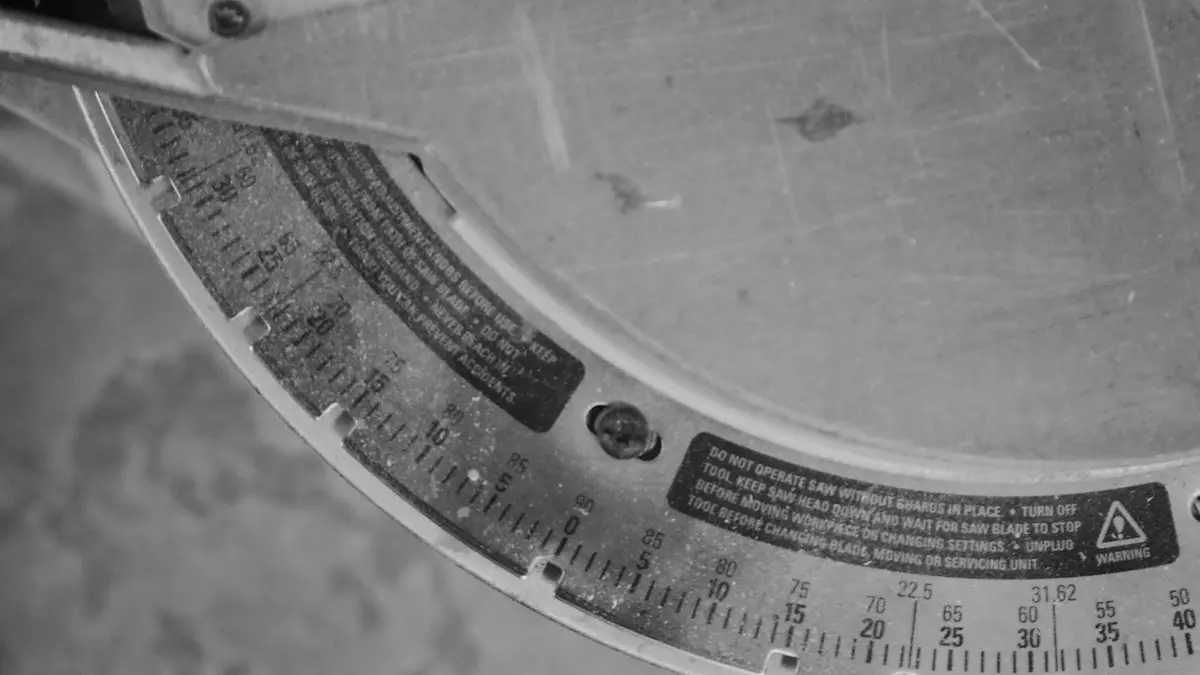
Source: Unsplash
Compatibility should be checked before purchase, especially if you expect to use replacement blades from multiple suppliers. Guidance on selecting metal-cutting blades likewise emphasizes starting with the material, matching blade geometry, and checking machine compatibility. Addison Saws
A dull, damaged, warped, or wrong blade is not a minor performance issue. It increases cutting effort and can worsen control. The Canadian Centre for Occupational Health and Safety advises users to inspect blades for damage, use the correct sharp blade for the stock, and avoid forcing the saw through the cut. CCOHS circular saw safety guidance
Plan the straight-cut system before buying
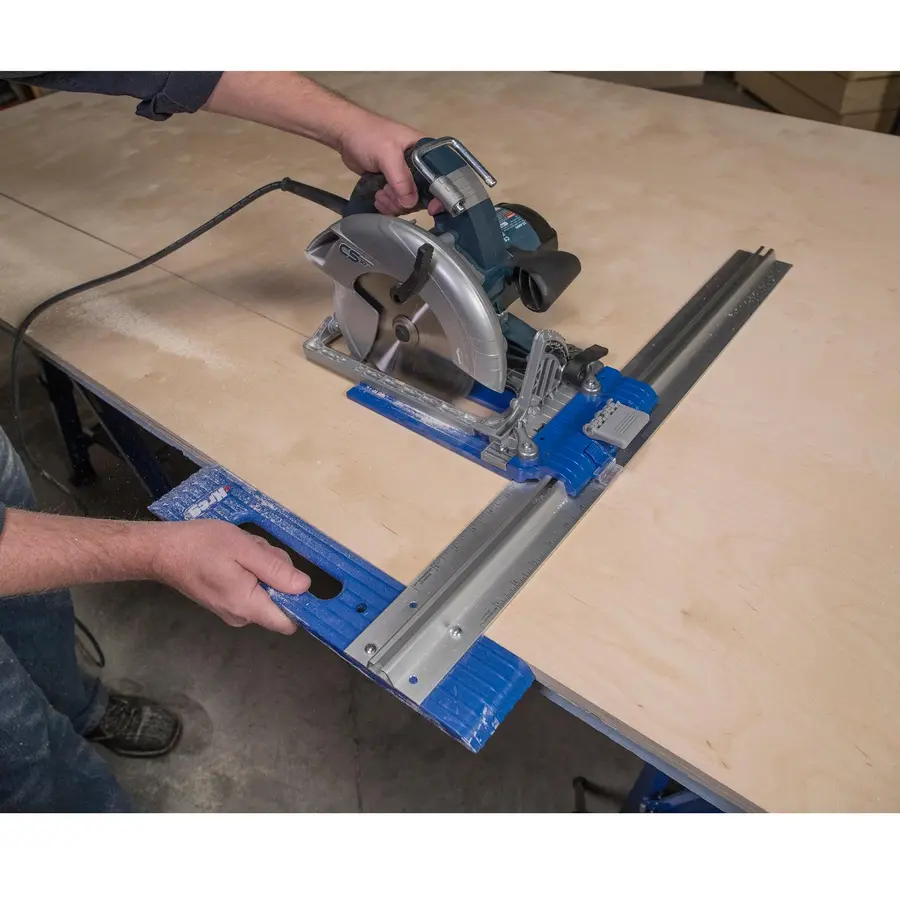
Long cuts are only as straight as the saw’s guidance and the stability of the workpiece. A saw’s included edge guide may be adequate for narrow, repeatable offsets, but it is not automatically a solution for long cuts across wide steel plate.
Track or guide-rail compatibility
Some saws are designed for a dedicated track or guide rail. Others can run against a clamped straightedge, and some are not intended to do either in a reliable way. Do not assume guide rails are universal.
Before buying, verify:
- Whether the manufacturer lists a compatible track or rail.
- Whether the saw base is designed to engage that track.
- Whether a guide can be used safely with the guard and chip outlet.
- The maximum practical cut length and availability of track connectors.
- Whether the saw can begin and end the cut without the guard hanging up on the guide or workpiece.
- Whether guide clamps clear the saw motor, base, and chip path.
A clamped straightedge can work when it is rigid, accurately placed, and secured outside the saw’s travel path. Account for the offset between the blade and the edge of the saw shoe; make a test cut on scrap to establish the actual offset for that setup.
Support matters as much as the guide
Support the material so it cannot vibrate, shift, pinch the blade, or drop into the kerf. Keep the offcut supported without trapping the blade as the cut closes. For large sheet, use a stable cutting table, sacrificial supports positioned clear of the blade path, or another arrangement that supports both sides of the cut.
Clamp the workpiece. Do not hold steel sheet with a hand near the cut line, and do not rely on body weight to keep a plate from moving. CCOHS specifically advises securing stock against movement and operating the saw with two hands. CCOHS circular saw safety guidance
Evaluate chip, spark, and cleanup control
Metal chips are a selection factor, not an afterthought. A saw that directs chips into a collection chamber or tray can make a substantial difference when cutting overhead, indoors, near machinery, or on finished surfaces.
Look for a chip-management design that you can inspect and empty easily. Also consider where chips will exit relative to your hands, legs, guide, clamps, and nearby surfaces. Fine metallic debris can remain sharp after the cut and can damage work surfaces or become a slip hazard.
Do not confuse metal chips with ordinary wood dust. Collect and dispose of them appropriately, and do not sweep them into areas where they can contaminate other work. Keep the motor and guards clear of accumulated debris; CCOHS includes keeping the motor free of dust and chips in its circular-saw guidance. CCOHS circular saw safety guidance
If using an abrasive wheel, plan for a much wider spark and debris zone. Remove combustibles, protect nearby people, and follow workplace requirements for hot work where applicable.
Corded versus cordless for metal cutting
Choose corded when sustained cutting is the priority
A corded saw is usually simpler for repeated long cuts, thicker material within capacity, or shop work where an outlet is available. There is no battery swap or runtime planning, and continuous power may be more convenient for a series of plate cuts.
Check extension-cord requirements in the saw manual. An undersized or overly long cord can affect tool performance and create an electrical hazard. Keep cords out of the cut path.
Choose cordless when mobility is the priority
A cordless saw can be useful for field installation, rooftop work, remote locations, or jobs with limited power access. The tradeoff is runtime, battery availability, and the need to avoid starting a long cut with insufficient charge.
Do not estimate performance from battery voltage alone. Compare the manufacturer’s documented material capacity, recommended battery range, and runtime information for the exact saw. Have enough charged batteries for the work, and follow the battery and charger instructions supplied by the manufacturer.
For either power source, a tool that slows, strains, or repeatedly stops under a normal feed rate needs attention. Stop and check blade condition, material suitability, cutting depth, chip buildup, power supply, and the manual before continuing.
Features worth prioritizing
For long straight cuts in steel, these features generally matter more than cosmetic extras:
- Published cutting depth for the intended material and blade.
- A readily available range of correct replacement blades.
- A clearly specified arbor size.
- A rigid, flat shoe that works with the intended guide arrangement.
- A functional retracting lower guard and robust fixed upper guard.
- Effective chip containment and straightforward chip-tray emptying.
- A clear sight line to the cut mark or guide edge.
- A comfortable two-hand grip and controls that remain usable with appropriate PPE.
- Practical weight for the length and orientation of the cuts you need to make.
Inspect the lower guard before each use. It should move freely and return to its protective position. Do not tie, wedge, or hold a guard open. CCOHS advises checking the retracting guard, and West Fraser likewise warns against altering the lower guard. CCOHS circular saw safety guidance West Fraser circular saw safety tips
When a circular saw is not the best choice
Choose another method when the job exceeds the saw’s documented capability or the shape and accuracy needs do not match a handheld circular saw.
A different tool may be better for:
- Thick plate or heavy structural sections: consider a suitable metal bandsaw, cold saw, plasma system, or shop cutting service.
- Curves and irregular profiles: use a bandsaw, jigsaw rated for the material, plasma cutter, or another process suited to the shape.
- Interior cutouts: use a method designed for plunge or internal cuts only when its manufacturer permits that operation.
- Very thin sheet prone to vibration: shears, nibblers, or other sheet-metal tools may offer better control and less distortion.
- Precision production cuts: a stationary cold saw, band saw, CNC process, or fabrication shop may produce more repeatable results.
- Unknown alloy, coated stock, or hazardous coatings: identify the material and determine appropriate controls before cutting.
Safety checks before the first cut
Metal cutting deserves a deliberate setup. Read the current saw and blade manuals before use, including their instructions for blade installation, allowed materials, depth settings, and maintenance.
At minimum:
- Wear safety glasses or goggles; add a face shield over eye protection when the task and site rules call for it.
- Use hearing protection in noisy work areas.
- Wear fitted clothing and secure long hair; keep loose clothing and jewelry away from moving parts.
- Use respiratory protection only when the material, coating, or work environment requires it, and follow applicable guidance for the hazard.
- Inspect the blade and guards with the tool unplugged or battery removed.
- Confirm blade rotation, blade tightness, and the correct depth setting according to the saw manual.
- Clamp and support the workpiece so it cannot move or bind.
- Keep your body out of the potential kickback path and maintain a balanced stance.
- Hold the saw with both hands and let it reach operating speed before entering the material.
- Feed steadily without forcing the saw.
- Wait for the blade to stop before setting the saw down.
Eye protection, hearing protection where required, guard inspection, two-handed operation, secure workholding, and avoiding forced cuts are all consistent with CCOHS circular-saw safety guidance. CCOHS circular saw safety guidance
A practical buying checklist
Before choosing a metal-cutting circular saw for steel sheet or plate, confirm these answers in writing from the current product documentation:
- Is the saw approved for the exact metal you will cut?
- What is its maximum rated cutting depth at 90 degrees and at any required bevel angle?
- Is that capacity comfortably above your thickest material?
- Which blade diameter, arbor bore, blade type, and maximum blade RPM does it require?
- Are suitable replacement blades readily available for mild steel, stainless, aluminum, or other materials you use?
- Does the saw work with a manufacturer-approved track, or can its shoe safely run against your chosen straightedge?
- How will you support the main piece and offcut throughout a long cut?
- Where do chips and sparks go, and can the work area safely accommodate them?
- For cordless models, what battery setup does the manufacturer specify for the expected workload?
- If the job is beyond the tool’s rating, which alternate cutting method is safer and more accurate?
The best choice is not simply the largest blade or highest advertised capacity. It is the saw-and-blade system that is documented for your material, leaves adequate capacity margin, follows a workable straight-cut guide plan, and lets you manage chips, sparks, workholding, and power safely.
References
- 7 Essential Circular Saw Safety Tips You Shouldn’t Ignore | Blogs. (n.d.). https://store.evolutionpowertools.com/blogs/news-and-stories/5-essential-circular-saw-safety-tips-you-can-t-ignore
- Bandsaw vs. Circular Saw: Choosing the Right Tool for Metal Cutting - SawbladeUniversity.com. (n.d.). https://sawbladeuniversity.com/bandsaw-vs-circular-saw-choosing-the-right-tool-for-metal-cutting
- How to Choose a Circular Saw Blade for Metal Cutting. (n.d.). https://www.addisonsaws.co.uk/how-do-i-choose-the-right-circular-saw-blade-for-metal-cutting
- Cutting Metal with a Skil Saw: Blades & Safety Tips. (n.d.). https://skylinestoneproducts.com/blogs/news/cutting-metal-with-a-skil-saw
- Circular Saw Safety | West Fraser - Integrated Forestry Company. (n.d.). https://osb.westfraser.com/blog/circular-saw-safety-tips
- Choosing the Right Circular Saw Blade for Your Project. (n.d.). https://carbidesawblade.com/blogs/sawingtips/choosing-the-right-circular-saw-blade-for-your-project
- Circular Saw Safety - PITB. (n.d.). https://www.pitb.com/circular-saw-safety
- Choosing the Correct Saw And Saw Blade For Cutting Metal …. (n.d.). https://blog.metaldeck.com/cutting-metal-decking-saw-blade
- CCOHS: Powered Hand Tools - Saws - Circular. (n.d.). https://www.ccohs.ca/oshanswers/safety_haz/power_tools/saw_circ.html
- Metal-Cutting Circular Saw Safety Guide | PDF - Scribd. (n.d.). https://www.scribd.com/presentation/490131761/ssaafety
 How to Check and Adjust a Circular Saw for Square Cuts
 Circular Saw Cut Depth: How to Tell Whether Your Saw Can Cut the Material
 How to Make a 45-Degree Rip Cut With a Circular Saw