A circular saw can cut a material in one pass only when the saw’s published maximum depth of cut at the planned bevel angle is greater than the material’s actual thickness. Do not assume a 6-1/2-inch saw cuts 6-1/2 inches deep, or that every saw with the same blade diameter has identical capacity.
For a straight 90-degree cut, a standard 7-1/4-inch handheld circular saw commonly has about 2-1/2 inches of maximum capacity, which is enough for a 2x4’s actual 1-1/2-inch thickness. Compact saws with smaller blades may still cut a 2x4, but only if their manual lists a 90-degree depth greater than 1-1/2 inches. Beveling reduces that capacity substantially.
Blade diameter is not cut depth
Blade diameter is the outside diameter of the blade. Cut depth is the farthest the blade teeth can reach below the saw’s base shoe while the saw is set on the material.
Several parts of the saw reduce the usable depth below the blade radius:
- The base shoe sits on top of the workpiece.
- The arbor, blade washers, guard, and motor housing occupy space near the blade center.
- The saw’s depth-adjustment design limits how far the blade can extend.
- The blade may not be set to its deepest position for ordinary cutting.
That is why the blade size printed on the saw is only a starting point. The saw manufacturer’s specifications or manual should list maximum depth at 90 degrees and, often, at 45 degrees. Those are the numbers to compare with the stock you plan to cut.
Typical handheld-saw capacities vary by design. A 5-1/2-inch compact saw is often around 1-5/8 to 1-3/4 inches at 90 degrees, while many 7-1/4-inch saws are around 2-1/2 inches. These are rough categories, not interchangeable specifications; published figures for similar blade sizes differ among sources and saw designs. Examples of common blade-size and depth ranges are useful for orientation, but the manual for the exact saw controls.
Can a circular saw cut a 2x4?
Usually, yes—at 90 degrees—but check the rating first.
A nominal 2x4 is normally about 1-1/2 inches thick by 3-1/2 inches wide. To crosscut or rip it in one pass, your saw needs a maximum 90-degree cutting depth greater than 1-1/2 inches. A saw rated exactly 1-1/2 inches is not a comfortable choice because a small setup error, a cupped board, or incomplete blade extension can leave fibers uncut.
Use this quick comparison:
| Planned cut | Minimum capacity to look for |
|---|---|
| 1/2-inch plywood | More than 1/2 inch at the planned bevel angle |
| 3/4-inch plywood | More than 3/4 inch at the planned bevel angle |
| 1x lumber, actual thickness about 3/4 inch | More than 3/4 inch at the planned bevel angle |
| 2x lumber, actual thickness about 1-1/2 inches | More than 1-1/2 inches at the planned bevel angle |
| 4x lumber, actual thickness about 3-1/2 inches | More than 3-1/2 inches at the planned bevel angle |
A typical 7-1/4-inch circular saw does not cut through a 4x4 in one pass. Trying to force a one-pass cut beyond the saw’s capacity is not a workaround. If a two-sided cut is appropriate, plan and mark it carefully; otherwise, choose a saw or cutting method designed for the stock.
Compact circular saw cutting capacity
A compact circular saw can be a sensible choice for plywood, paneling, trim, and thinner lumber because it is lighter and easier to handle. Its limitation is depth, not necessarily cutting quality.
Before buying or using one, look for these two lines in the specification sheet:
- Maximum depth of cut at 90 degrees for square cuts.
- Maximum depth of cut at 45 degrees for common bevel cuts.
A compact saw whose 90-degree rating exceeds 1-1/2 inches may handle ordinary 2x lumber squarely. That does not mean it will handle the same lumber at a 45-degree bevel. Small-blade saws often lose enough capacity at a bevel that 2x material is no longer a one-pass cut.
Also confirm the blade size and arbor requirement in the manual before replacing a blade. A blade that fits the arbor hole is not automatically approved for the saw; guard clearance and the tool’s rated blade diameter matter. If the manual does not approve a blade size or type, do not assume it is compatible.
Why bevel cuts reduce circular saw capacity
Tilting the saw makes the blade travel diagonally through the material instead of straight down through it. The material is effectively thicker along that angled path, so the same blade cannot reach as far through it.
For example, sources commonly list a 7-1/4-inch saw at roughly 2-1/2 inches of depth at 90 degrees and around 1-7/8 inches at 45 degrees. The exact figures vary by saw, but the pattern is consistent: the 45-degree capacity is meaningfully lower than the straight-cut capacity. This comparison of typical saw sizes illustrates why a saw that easily clears 2x lumber at 90 degrees may be marginal or unsuitable for a 45-degree cut.
Do not estimate bevel capacity from blade diameter or rely solely on a depth scale. Set the bevel angle, confirm the manufacturer’s rating for that angle, and compare it with the actual material thickness.
How to check whether your saw will make the cut
Use this checklist before you start:
1. Measure the real material
Measure the thickness of the actual board, sheet, or assembled material. Nominal lumber names are not its finished dimensions. Include anything that makes the cut thicker, such as a layered panel or material that is not lying flat.
2. Identify the planned cut angle
Use the 90-degree capacity only for a square cut. For any bevel, use the manufacturer’s capacity at that bevel angle. A 45-degree rating is not automatically valid for every intermediate or steeper bevel; check the manual’s specification table.
3. Check the exact saw manual
Find the maximum depth-of-cut specification for the saw model, not a generic chart. The shoe, guard arrangement, and motor layout affect usable depth, so two saws using the same nominal blade diameter can differ.
4. Leave a little practical margin
The rated maximum is a physical limit, not an ideal everyday target. A saw with slightly more capacity than the material thickness gives room for normal variation in stock and setup. If the numbers are too close, use a larger-capacity saw or change the cutting plan.
5. Set the working blade depth after confirming capacity
Once you know the saw has enough maximum capacity, adjust the shoe so the blade extends only slightly below the workpiece. Excessive blade exposure increases the amount of blade below the cut and can increase the consequences of a loss of control. Guidance on circular-saw depth adjustment commonly recommends only modest blade projection below the stock; verify the procedure for your saw in its manual. Depth-adjustment guidance explains the basic principle.
A safe setup matters as much as capacity
Depth capacity answers whether the blade can physically pass through the material. It does not guarantee a safe or clean cut.
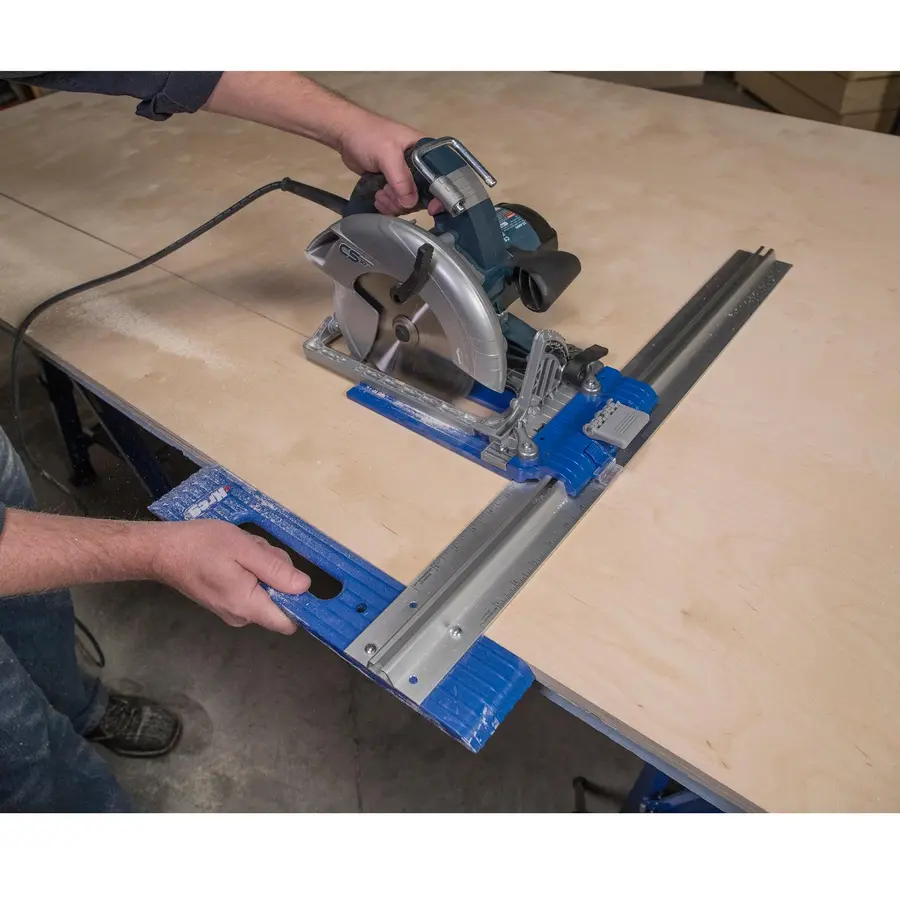
Support the workpiece so the kerf can open rather than pinch the blade. Keep both hands in their intended positions, keep the lower guard working freely, and keep hands and cords away from the blade’s path. Do not hold a short offcut where it can shift into the blade. A binding blade can cause kickback, which can throw the saw toward the operator.
Inspect the blade, guards, depth lock, bevel lock, and shoe before use. If a guard does not return correctly, a lock does not hold, or the saw’s manual is unavailable for an uncertain setup, stop and resolve that issue before cutting. Circular-saw safety guidance emphasizes working guards, correct depth setting, workpiece support, and procedures that prevent blade binding and kickback. Read the safety overview.
Use the blade and operating method approved for the material. For metal, masonry, plastics, composites, or engineered products, check the saw and blade manufacturers’ current instructions for material suitability, speed rating, dust controls, and required protective equipment. Do not rely on a wood-cutting capacity chart for those materials.
The simple rule
Compare actual material thickness with the saw’s published depth rating at your exact bevel angle. If the rating comfortably exceeds the thickness, the saw can make the cut in one pass. If it does not, changing to a larger blade on an unapproved saw is not the answer—use a saw or method with the required documented capacity.
References
- Circular Saw: Blade Diameter, Arbor Size & Cutting Depth. (n.d.). https://cnenum.com/impact-of-blade-diameter-and-arbor-size-on-circular-saw-cutting-depth-and-compatibility
- Match the Right Blade to Wood Thickness + Free Chart. (n.d.). https://www.uf-tools.com/power-saw-blade-size-guide-match-the-right-blade-to-wood-thickness-free-chart
- What Size Blade Circular Saw? - Complete Guide. (n.d.). https://toolsadvisers.com/what-size-blade-circular-saw
- Circular Saw Depth of Cut. How Deep Can a Saw Cut?. (n.d.). https://www.finepowertools.com/saws/circular-saw-depth
- How Deep Can Circular Saw Cut? - Max Depth Guide. (n.d.). https://toolsadvisers.com/how-deep-can-circular-saw-cut
- How Deep Can a Circular Saw Cut? Understanding Cutting Depths Across Different Sizes. (n.d.). https://onevantool.com/blogs/news/how-deep-can-a-circular-saw-cut
- Mastering The Craft: Setting Blade Depth On Your Circular Saw | ShunTool. (n.d.). https://shuntool.com/article/how-to-set-blade-depth-on-circular-saw
- How Deep Does A Circular Saw Cut? - Depth Explained Simply. (n.d.). https://toolsadvisers.com/how-deep-does-a-circular-saw-cut
- How Deep Can A 10 Inch Circular Saw Cut? - Complete Guide. (n.d.). https://toolsadvisers.com/how-deep-can-a-10-inch-circular-saw-cut
- Circular Saw Safety: Guarding & Operating Guide. (n.d.). https://www.hseblog.com/circular-saw-safety
 How to Make a 45-Degree Rip Cut With a Circular Saw
 Can You Rip Cut Wood With a Miter Saw?
 Why a Circular Saw Burns Wood: Causes, Checks, and Fixes