A circular saw burns wood when friction creates more heat than the cut can shed. The usual causes are a dirty or dull blade, the wrong blade for the material, an overly slow feed rate, a blade set too deep, a cut that is closing on the blade, or a saw that is losing power under load.
Stop cutting if you see smoke, smell scorching, hear the motor laboring, or feel the saw pull sideways. Let the blade stop, unplug the saw or remove its battery as directed by the manufacturer, and inspect the setup before trying again. Do not force a smoking saw through the cut.
Start With the Blade
The blade is the most likely source of circular saw burn marks. A blade that cannot cut cleanly rubs and scrapes wood fibers instead. That friction darkens the cut edge, produces the familiar burnt-wood smell, and may create smoke.
Check for pitch and resin buildup
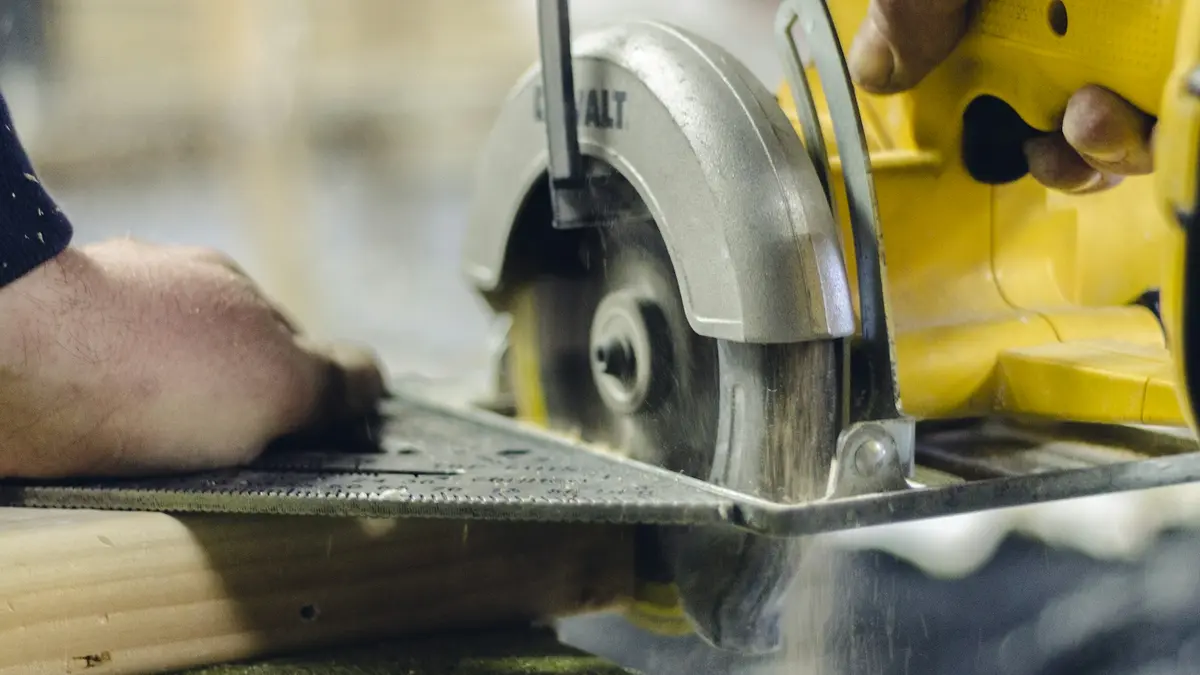
Wood resin, sap, glue residue, and fine dust can collect around blade teeth and along the blade plate. This is especially common after cutting resinous softwoods, plywood, and engineered sheet goods. A dirty blade can behave much like a dull one because buildup interferes with cutting and chip clearing.
Source: Unsplash
Inspect the blade under good light. Look for a brown, black, or sticky coating around the teeth. If the carbide teeth appear intact and the buildup is the obvious problem, clean the blade using a cleaner and method approved by the blade manufacturer. Follow the cleaner label and the saw and blade instructions. Avoid aggressive scraping, grinding, or methods that could damage the teeth, coating, or blade body.
After cleaning, make a short test cut in scrap of the same material. If the saw still burns the wood, treat the blade as dull, damaged, unsuitable, or incorrectly installed until proven otherwise.
Look for dull or damaged teeth
A dull blade takes noticeably more effort to push through wood. The motor may sound strained, the cut may look rough, and burning often becomes worse during long rip cuts or in dense hardwood. Missing, chipped, or uneven teeth can also leave a rough cut and increase friction.
Replace the blade or have it professionally serviced when appropriate for that blade type. Do not assume a blade is serviceable merely because it looks clean. Also do not use a blade that appears bent, cracked, warped, or otherwise damaged.
Verify the replacement blade’s diameter, arbor fit, permitted use, and installation direction in the current saw manual and blade documentation. Blade compatibility and installation requirements vary by saw.
Use a blade intended for the material and cut
A general-purpose wood blade may not perform well in every situation. Plywood, laminate-faced panels, hardwood, pressure-treated lumber, MDF, and thick framing material can each place different demands on a blade.
A blade with too few teeth can leave a rougher finish on crosscuts and sheet goods. A blade not intended for the material may cut slowly, load with residue, or create excess heat. Select a blade identified by its maker for the material and the type of cut you are making.
MDF and other engineered panels deserve extra attention. Their binders and fine dust can be hard on blades, and a blade that was acceptable at the beginning of a project may no longer cut well after repeated use.
Set Up the Cut So the Blade Does Not Rub
A sharp, clean blade can still burn wood if the work shifts, the saw is steered off line, or the kerf closes around the blade.
Set blade depth correctly
An unnecessarily deep blade puts more blade body and more teeth into the work than needed. That can increase drag and makes it easier for the saw to wander or rub.
Set the blade depth according to the current manufacturer manual for your saw and operation. Before cutting, confirm that the depth is suitable for the material and that nothing below the workpiece will contact the blade.
Check whether the kerf is closing
If a board sags, twists, or is supported poorly, the two sides of the cut can press together behind the blade. The result may be burning on one side of the kerf, a slowing motor, resistance near the end of the cut, or a saw that begins to drift.
Support the workpiece and offcut so neither section can pinch the blade as the cut progresses. Keep the cut path clear, and use a setup that lets the offcut move away naturally rather than trapping it. For more on diagnosing this problem, see why wood binds when cutting with a saw.
If the blade binds, the saw twists, or the guard does not operate normally, stop work. Review the current manufacturer instructions for the saw and cutting setup before continuing. Binding can create an unsafe loss of control.
Keep the saw moving straight
Side pressure is a common hidden cause of circular saw burning cuts. If you twist the saw to follow a line, use a guide that is not straight, or let the work move during the cut, the blade can rub one wall of the kerf.
Use a straight guide when accuracy matters, secure the workpiece appropriately, and watch the saw’s base rather than trying to steer the blade back onto a wandering line. If the saw consistently pulls to one side with a known-straight guide, stop and inspect the blade and saw rather than compensating with more hand pressure.
Adjust Your Feed Rate
Feed rate is a balance. Moving too slowly lets the blade dwell in one area and rub long enough to leave a burn mark. Moving too fast overloads the blade and motor, which can also create heat and a rough cut.
Let the saw reach normal cutting speed as directed by its manufacturer, then advance at a steady pace. The saw should cut without excessive force or a dramatic drop in motor sound. If the motor bogs down, reduce pressure and reassess the blade, material, and cut setup. If the saw is moving freely but leaving a polished or dark edge, a slightly steadier forward feed may help—but only after the blade and kerf have been checked.
Long rip cuts are especially prone to burning because the blade stays in the wood for more time. Dense hardwood, knots, wet lumber, and material with internal stress can add resistance as well.
Check the Saw if a Good Blade Still Burns
If a clean, sharp, correct blade burns wood in a properly supported, straight cut, the problem may be the saw.
Signs of a saw-performance problem
Possible warning signs include:
- The motor sounds weak or slows unusually under a normal load.
- The blade appears to wobble or the cut is wider and rougher than expected.
- The saw vibrates more than usual.
- The blade does not sit flat or clamp securely on the arbor.
- The saw produces burning with more than one known-good blade.
Disconnect power as directed by the manufacturer before inspection. Check that the blade is seated and secured exactly as the manual specifies. Do not use a saw with suspected arbor damage, worn mounting parts, unusual vibration, or a blade that will not run true.
For corded models, power-delivery and motor issues should be diagnosed according to the manufacturer’s instructions or by a qualified repair provider. For cordless models, confirm the battery, tool, and charger are being used and maintained as the manufacturer specifies. Do not modify the tool or bypass protective components.
Quick Troubleshooting Sequence
Use this order to avoid replacing parts unnecessarily:
- Stop cutting when smoke or heavy burning appears.
- Inspect the blade for resin, pitch, missing teeth, damage, or obvious dullness.
- Clean a sound blade using the blade maker’s approved method.
- If cleaning does not solve the problem, install a suitable sharp blade that is approved for the saw and material.
- Check blade depth against the current saw manual.
- Rebuild the work support so the kerf cannot close on the blade.
- Make a controlled test cut in scrap, keeping the saw aligned and moving at a steady pace.
- If burning, vibration, wandering, or power loss continues, take the saw out of service for inspection or repair.
How to Prevent Burn Marks
Keep blades clean, change them before they become hard to push, and reserve blades for materials they are intended to cut. A blade used repeatedly on plywood, MDF, or resinous lumber may need attention sooner than one used occasionally on clean dimensional lumber.
Before each longer cut, check the work support, the cut line, and whether the offcut has room to fall or move away without closing the kerf. A straight guide is often more effective than trying to correct the saw by hand halfway through the cut.
Regular blade care also makes problems easier to diagnose. For broader upkeep guidance, see circular saw blade maintenance.
When Cleaning Is Not Enough
Cleaning is appropriate when buildup is the likely issue and the blade is otherwise sound. It is not a cure for worn teeth, chipped carbide, a warped blade, a poor blade choice, binding wood, or a saw with mechanical problems.
Replace the blade when it remains hard to push after cleaning, repeatedly burns wood in a sound setup, has damaged teeth, or shows any sign of physical damage. Seek service for the saw when a verified good blade still wobbles, the motor loses power abnormally, or the saw cannot make a straight cut without side pressure.
References
- Why is My Circular Saw Burning the Wood?. (n.d.). https://www.tenyutool.com/why-is-my-circular-saw-burning-the-wood
- Why Does My Circular Saw Burn The Wood? - Complete Guide. (n.d.). https://toolsadvisers.com/why-does-my-circular-saw-burn-the-wood
- Why Is My Circular Saw Burning Wood? - Complete Guide. (n.d.). https://toolsadvisers.com/why-is-my-circular-saw-burning-wood
- Circular Saw Smokes When Cutting Wood? - Causes & Fixes. (n.d.). https://toolsadvisers.com/circular-saw-smokes-when-cutting-wood
- How to Tell If a Circular Saw Blade Is Dull?. (n.d.). https://www.pagtonprotools.com/blog/how-to-tell-if-a-circular-saw-blade-is-dull
- Circular saw burn marks on wood. What am I doing wrong?. (n.d.). https://www.facebook.com/groups/1493326978176093/posts/1730828647759257
- Can someone tell me why my circular saw is burning when …. (n.d.). https://www.reddit.com/r/BeginnerWoodWorking/comments/1kg4jpy/can_someone_tell_me_why_my_circular_saw_is
- Why Is My Circular Saw Blade Smoking? Causes And Fixes. (n.d.). https://toolsadvisers.com/why-is-my-circular-saw-blade-smoking
- 7 Signs You’re Using the Wrong Circular Saw Blade – Key Blades & Fixings. (n.d.). https://www.keybladesfixings.co.uk/blogs/circular-saw-blades/top-7-signs-you-re-using-the-wrong-circular-saw-blade
- Saw Burn Marks? See How to Get Clean Saw Cuts in Wood. (n.d.). https://www.youtube.com/watch?v=Hz3E6dEmT4A
 Why a Circular Saw Blade Deflects During a Cut and How to Troubleshoot It
 Why Wood Binds During Saw Cuts and How to Prevent It
 Which Way Does a Circular Saw Blade Go? How to Check Installation Safely