No. Do not put a conventional circular-saw blade on an angle grinder, even if the arbor hole, nut, or blade diameter appears to fit. A physical fit does not establish that the blade is rated for the grinder’s speed, retained correctly by its flanges, covered by the correct guard, or approved by the grinder manufacturer.
The main danger is violent kickback. A toothed blade can grab, bind, or climb out of a cut, while an angle grinder lacks the base plate, depth control, and lower blade guard that make a circular saw manageable. A safety analysis of this conversion specifically warns that twisting or tipping can jam teeth in the kerf and force the tool back toward the operator. Robson Forensic explains the hazard.
Why a circular-saw blade and grinder are not a compatible system
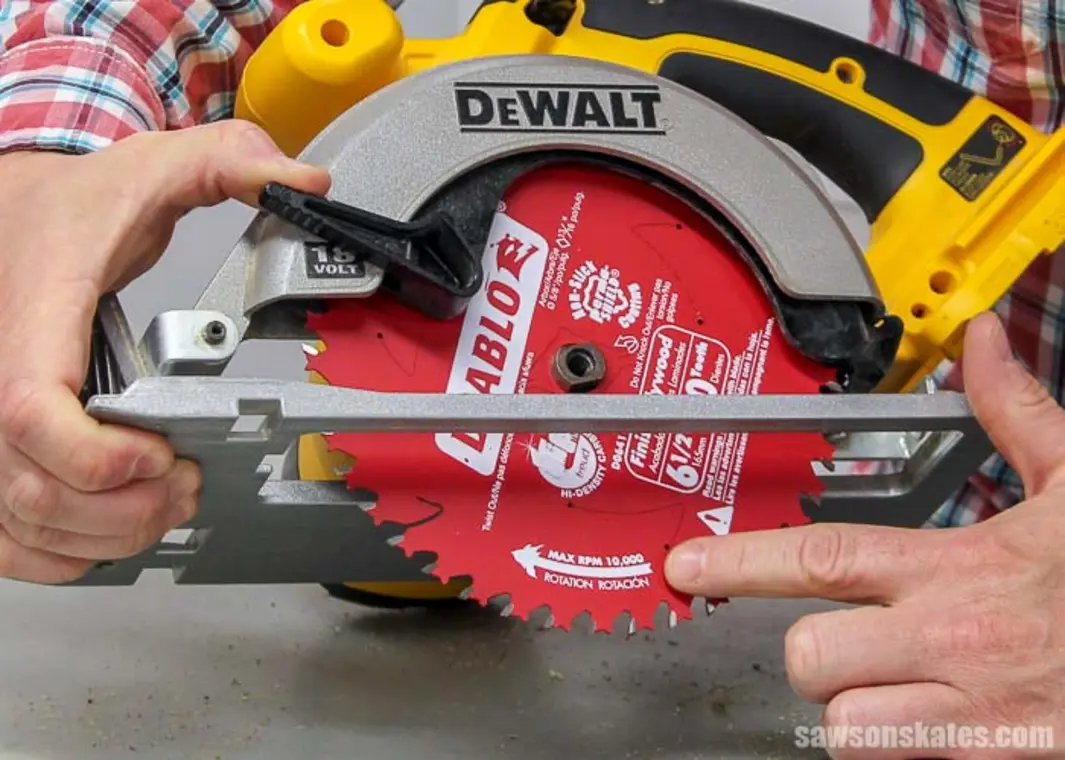
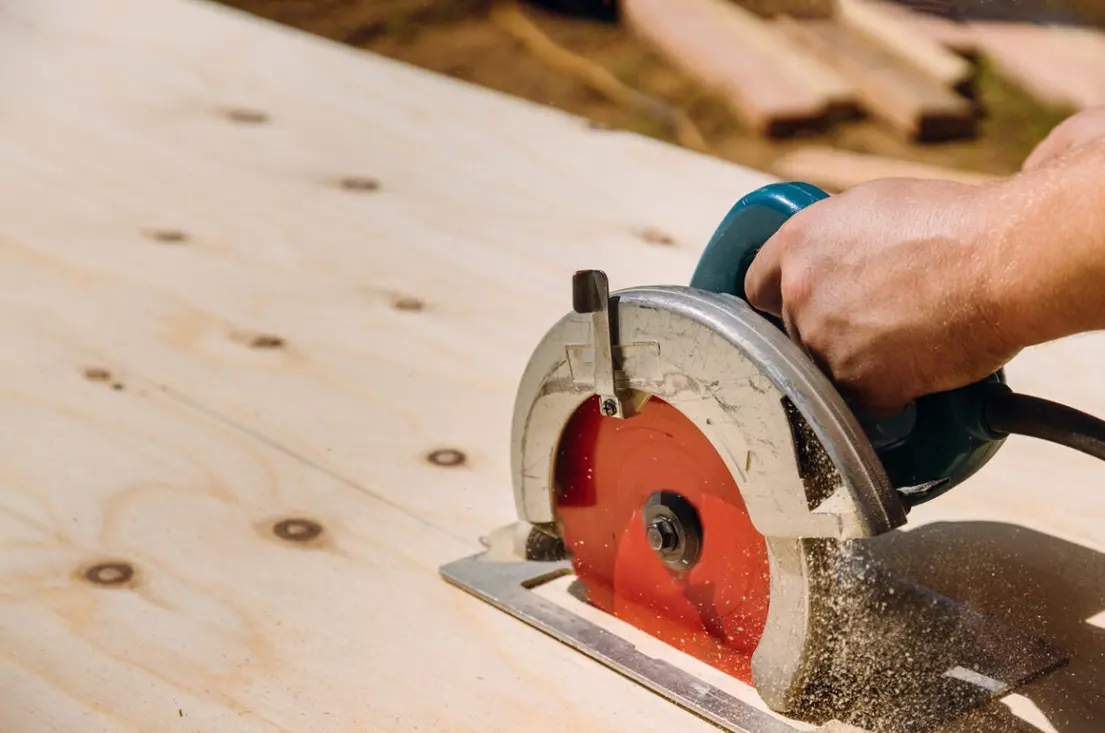
A circular saw is built to make a controlled straight cut from a stable base. Its shoe rests on the workpiece, limits how far the blade enters the material, and helps resist twisting. Its retracting lower guard covers the unused teeth. Circular-saw safety guidance emphasizes checking that lower guard and setting a shallow cutting depth rather than leaving a large portion of the blade exposed. CCOHS circular-saw guidance describes these features and practices.
An angle grinder is designed around grinding, sanding, wire-brushing, and cutting accessories specifically listed for that grinder. Its side handle helps control the tool, but it does not replace a saw’s base plate. Its wheel guard is also not a lower blade guard: it cannot enclose the exposed teeth of a circular-saw blade or control the depth of a wood cut.
Why the setup can kick back so quickly
Kickback begins when the rotating accessory pinches, snags, or stalls in the workpiece. The tool can then be driven suddenly in the opposite direction of rotation at the binding point. This is a recognized hazard for rotating cutting accessories; the operating manual supplied for a compact circular saw describes kickback as a sudden reaction to a pinched or snagged rotating wheel and notes that the tool may be forced out of control. See the manual’s kickback warning.
With a toothed blade on a grinder, several conditions make that loss of control more likely:
- No base plate: The tool can tip, twist, or plunge deeper into the work instead of staying at a controlled depth.
- Aggressive tooth engagement: Teeth can catch the wood rather than abrade or grind it away gradually.
- Changing cut angle: A handheld grinder is easy to move sideways or rotate during a cut. That can pinch the blade in the kerf.
- Limited tooth coverage: Much of the blade may remain exposed during and after the cut.
- Fast, powerful tool response: Once teeth bind, the tool can move before the operator can correct it.
A toothed-blade attachment should not be treated as safe simply because it is sold with an arbor adapter or marketed for a grinder. Product safety authorities have issued alerts that toothed saw-blade attachments for angle grinders can cause kickback and loss of control. Product Safety UK’s alert is a useful reminder that the hazard is the overall tool-and-accessory combination, not just whether the blade can be mounted.
Speed rating matters, but it is not the only check
An accessory must be rated for at least the tool’s maximum no-load speed. Check the grinder’s rating plate and current manual, then check the accessory label or packaging for its maximum permitted RPM. Do not assume that a blade made for a circular saw is suitable because its diameter is similar to a grinder wheel.
However, a blade with an adequate speed marking still does not make this conversion acceptable. Safe accessory compatibility also depends on the exact tool model, accessory type, diameter, arbor arrangement, flanges, retaining hardware, guard, and intended operation. The grinder manufacturer’s current manual is the controlling source for which accessories are permitted.
Do not modify a guard, remove a guard, use improvised spacers, alter the arbor hole, stack flanges, or rely on an adapter to make an unapproved blade fit. Those changes can affect clamping, balance, clearance, and guarding.
What to use instead
Choose the tool based on the cut you need to make:
For straight cuts in lumber or sheet goods
Use a circular saw, track saw, or other purpose-built wood-cutting saw. These tools provide a base plate, appropriate blade guarding, and controlled cutting depth. For safe operation, inspect the blade and guard, support the workpiece, and keep both hands available for tool control as the saw manufacturer directs. CCOHS guidance on circular-saw guards and blade condition covers these basics.
For small cuts, notches, or flush work
An oscillating multi-tool with a blade approved for the material can be more controllable than a large exposed toothed blade. A reciprocating saw may also be suitable where its shoe can be held against the workpiece.
For metal, masonry, or grinding work
Use the angle grinder with the correct approved abrasive cutting wheel, grinding wheel, flap disc, wire accessory, or diamond accessory for the material and operation. Confirm the exact accessory is listed or allowed by the grinder’s manual, is within the permitted size range, and is used with the specified guard.
If you have already mounted a saw blade
Do not test it in the air or make a trial cut. Disconnect the grinder from power, or remove its battery if applicable, following the tool manufacturer’s instructions. Then remove the blade and reinstall only an accessory that the manual approves for that model.
Before using any grinder accessory, verify the tool’s current manual for maximum accessory diameter, allowable accessory categories, required guard, flange arrangement, direction of installation, and maximum accessory speed. Wear the personal protective equipment specified by the tool and accessory manufacturers, but do not treat eye, face, hearing, or respiratory protection as a solution to an incompatible blade setup.
Bottom line
A circular-saw blade on an angle grinder is not a safe substitute for a circular saw. The arbor may accept it, but the grinder does not provide the support, depth control, tooth guarding, or approved operating system needed for a toothed wood-cutting blade. Use a purpose-built saw for wood cuts and reserve the angle grinder for accessories its manufacturer specifically authorizes.
References
- The Dangers of Fitting a Circular Saw Blade to an Angle Grinder. (n.d.). https://www.robsonforensic.com/articles/angle-grinder-cutting-wheel-injury-expert-witness
- ⚠️ Important product safety alert Toothed saw blade …. (n.d.). https://www.facebook.com/ProductSafetyUK/posts/%EF%B8%8F-important-product-safety-alert-toothed-saw-blade-attachments-for-angle-grinder/1428788156107458
- SAFETY AND OPERATING MANUAL. (n.d.). https://gzhls.at/blob/ldb/9/5/8/9/742629267b55d71413af238dcc4668917546.pdf
- Circular Saw Safety | West Fraser - Integrated Forestry Company. (n.d.). https://osb.westfraser.com/blog/circular-saw-safety-tips
- CCOHS: Powered Hand Tools - Saws - Circular. (n.d.). https://www.ccohs.ca/oshanswers/safety_haz/power_tools/saw_circ.html
- r/OSHA would love this, Angle Grinder-Circular Saw. (n.d.). https://www.reddit.com/r/woodworking/comments/5qij0x/rosha_would_love_this_angle_grindercircular_saw
- SAW SAFETY Risk in the Real World. (n.d.). https://pmc.ncbi.nlm.nih.gov/articles/PMC9434728
- Is it ok to use a wood blade on an angle grinder installed …. (n.d.). https://www.lumberjocks.com/threads/is-it-ok-to-use-a-wood-blade-on-an-angle-grinder-installed-on-a-support.355528
- Can you use an angle grinder with a circular saw blade?. (n.d.). https://www.quora.com/Can-you-use-an-angle-grinder-with-a-circular-saw-blade
- Angle grinder saw blades - safe or no? : r/woodworking. (n.d.). https://www.reddit.com/r/woodworking/comments/1dcwkvx/angle_grinder_saw_blades_safe_or_no
 Why a Circular Saw Burns Wood: Causes, Checks, and Fixes
 Which Way Does a Circular Saw Blade Go? How to Check Installation Safely
 Why a Circular Saw Blade Deflects During a Cut and How to Troubleshoot It