The short answer
No—do not use a miter saw to rip lumber lengthwise. A miter saw is built to make crosscuts, miter cuts, and bevel cuts with the workpiece held against a fixed rear fence. It is not a substitute for a table saw, track saw, or circular saw guided along a cut line.
Even a sliding compound miter saw should not be treated as a ripping saw. Its sliding rails increase crosscut capacity across a board’s width; they do not provide a safe way to guide a long board parallel to its edge through the blade. Sources that discuss miter-saw ripping consistently identify the operation as unsafe and poorly controlled compared with using a purpose-built ripping method. ToolsAdvisers and Wood Handy reach the same practical conclusion: use another saw.
What makes a cut a rip cut?
A rip cut runs lengthwise along a board, usually parallel to the wood grain. Its common purpose is to make a board narrower—for example, turning a 1x6 into two narrower strips.
A crosscut runs across a board’s width, generally perpendicular to the grain. Cutting a framing board to length is a typical crosscut. A miter saw excels at this operation because the fence establishes the cut position and supports the board while the blade descends.
The terms can be less literal with plywood, MDF, and other sheet goods because they do not have a single continuous grain direction. In everyday shop use, though, “ripping” still usually means making a long, lengthwise cut to reduce width.
Why miter saws are not for ripping
A miter saw holds the material stationary while the blade comes down into it. Its fence is designed to locate the workpiece for a cut across its width, not to guide stock through a long, continuous cut.
Trying to rip on a miter saw creates several problems.
The board lacks proper guidance
A table saw uses a rip fence to keep the edge of a board on a consistent path relative to the blade. A track saw uses a guide rail over the workpiece. A circular saw can follow a straightedge or guide designed for the saw.
A miter saw has no equivalent system for holding and guiding a board through a lengthwise cut. Pushing, turning, shifting, or feeding the board sideways while the blade is running is not a controlled operation.
The workpiece can bind or move
Wood can move as internal stresses are released during a rip cut. If the kerf closes on the blade or the board shifts, the blade can bind. That can damage the workpiece, stall the cut, or create kickback and loss-of-control hazards.
Kickback is a serious risk with any saw operation when wood contacts the blade improperly. The correct safeguards and technique depend on the specific saw and operation, which is why a miter saw should be used only for the operations permitted in its current manual.
Support is inadequate for long stock
Long boards and sheet goods need stable support throughout the cut. On a miter saw, material extending far to either side can sag, pivot, or become difficult to hold flat against the fence and saw base. Support stands can help with normal crosscuts, but they do not turn the saw into a rip-cutting system.
A different blade does not solve the setup problem
Changing to a blade marketed for ripping does not add a rip fence, appropriate stock support, or the safety features needed for a ripping operation. Blade selection must also follow the saw manufacturer’s specifications for diameter, arbor size, permitted blade type, and speed rating. Verify those requirements in the current saw manual rather than assuming any blade that physically fits is approved.
Do not confuse a wide crosscut with a rip cut
A sliding miter saw can crosscut a wider board than a non-sliding saw because the saw head moves on rails. That movement is still intended to bring the blade through a board positioned against the fence.
For example, cutting a wide shelf board shorter is a crosscut, even if the saw head slides a considerable distance. Cutting that same board into narrower strips along its long dimension is ripping. The first may be within the saw’s stated crosscut capacity; the second is not made safe simply because the saw slides.
Do not turn the board sideways, hold it at an unapproved orientation, remove guards, clamp improvised guides to the saw, or make repeated passes to imitate a rip cut. If the cut does not fit the operation and capacity described in the saw’s manual, choose a different tool.
Safer alternatives for ripping lumber
The right alternative depends on the material, cut length, desired accuracy, and whether you are cutting solid lumber or sheet goods.
Table saw: best for repeated, accurate rips in solid lumber
A table saw is the conventional choice for repeatedly ripping boards to a consistent width. Its rip fence guides the workpiece along the blade, and its design is intended for this class of cut.
That does not make table-saw ripping risk-free. Before using one, read the current manual for the saw and follow its instructions for blade guards, fence position, push devices, workpiece size limits, outfeed support, and any anti-kickback equipment supplied with the saw. For more background on controlling the main hazard, see how to prevent table saw kickback.
Track saw: best for long, straight cuts in sheet goods
A track saw cuts along a guide rail placed on the workpiece. It is especially useful for breaking down plywood and other panels, including material that is awkward to handle on a table saw. The rail provides a defined cutting path without requiring the full sheet to be pushed across a stationary blade.
Support the entire panel so the offcut cannot drop, pinch the blade, or tear away before the cut is complete. Check the saw manual for approved support methods, blade requirements, and plunge-cut procedures.
Circular saw with a straightedge: useful for occasional long cuts
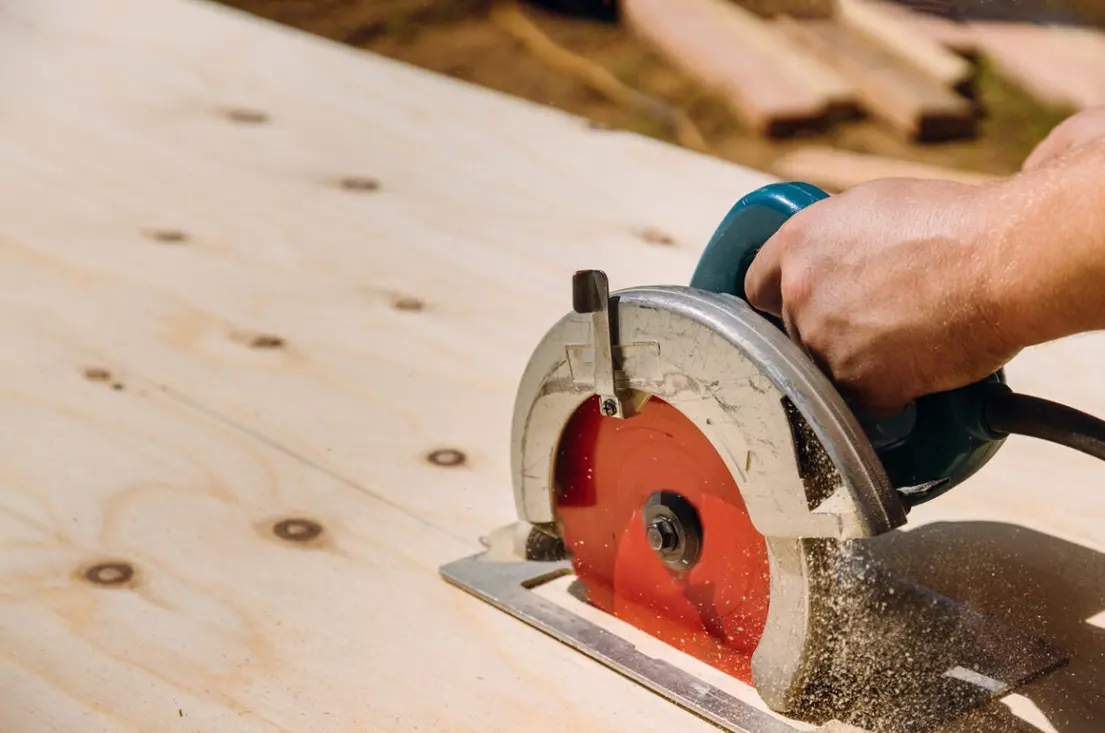
A circular saw paired with a suitable straightedge or guide can make long rip cuts in lumber and sheet goods. This is often a practical option when space is limited or the workpiece is too large for a table saw.
The guide must be firmly positioned, the material must be supported on both sides of the cut, and the blade depth and cutting method must follow the saw manufacturer’s instructions. If you are cutting plywood, see how to cut plywood straight with a circular saw.
Have a lumberyard cut oversized stock first
For a single rough size reduction, a lumberyard or woodworking shop may be able to make the initial cut. You can then use a miter saw for the crosscuts, miters, and trim pieces it is designed to handle.
Choosing the right saw for the job
Use this simple distinction:
- Need to shorten a board or make an angle across it: Use a miter saw if the material is within the saw’s stated capacity.
- Need to make a board narrower along its length: Use a table saw, track saw, or guided circular saw.
- Need to break down a full plywood sheet: Prefer a track saw or circular saw with a guide and full workpiece support.
- Need many identical narrow strips from solid lumber: Use a properly set up table saw, following its manual and required safety practices.
A table saw and miter saw are complementary rather than interchangeable. The miter saw is the efficient choice for precise length and angle cuts; the table saw is designed to establish consistent width through rip cuts. For a broader comparison of where saw types fit, see track saw vs. table saw.
Before making any cut
Confirm that the material is straight enough to sit securely, that it is free of embedded fasteners or other hidden obstructions, and that it is fully supported. Keep the saw’s guards and safety equipment installed as specified by the manufacturer. Use eye and hearing protection as directed in the tool manual and applicable safety guidance.
Most importantly, do not force a miter saw to perform a cut that needs a guided ripping setup. If you need to rip a board and do not have a suitable saw or guide system, pause the project and use a safer method.
References
- Mastering The Miter Saw: Unveiling The Secrets To Making Perfect Rip Cuts | ShunTool. (n.d.). https://shuntool.com/article/can-you-make-rip-cuts-with-miter-saw
- Can You Use A Miter Saw Like A Table Saw – Safe & Smart …. (n.d.). https://thejimbosliceworkshop.com/can-you-use-a-miter-saw-like-a-table-saw
- Can You Use A Miter Saw To Rip Boards? Safety First!. (n.d.). https://toolsadvisers.com/can-you-use-a-miter-saw-to-rip-boards
- Can A Miter Saw Rip Boards? A Complete Guide. (n.d.). https://toolsadvisers.com/can-a-miter-saw-rip-boards
- Can You Rip a Board on a Miter Saw?. (n.d.). https://bestsawguide.com/can-you-rip-a-board-on-a-miter-saw
- Can A Miter Saw Cut Lengthwise? - Complete Guide. (n.d.). https://toolsadvisers.com/can-a-miter-saw-cut-lengthwise
- Can You Rip With A Miter Saw? A Complete Guide. (n.d.). https://toolsadvisers.com/can-you-rip-with-a-miter-saw
- How To Rip A Board With A Miter Saw? - The Easy Guide. (n.d.). https://toolsadvisers.com/how-to-rip-a-board-with-a-miter-saw
- Understanding The Rules: Is Ripping Allowed On A Miter Saw?. (n.d.). https://shuntool.com/article/is-ripping-allowed-on-a-miter-saw
- Can You Rip with a Miter Saw: 6 Reasons Not to Do It. (n.d.). https://woodhandy.com/can-you-rip-with-a-miter-saw-6-reasons-not-to-do-it
 How High Should a Table Saw Blade Be for Rip Cuts?
 Why a Circular Saw Burns Wood: Causes, Checks, and Fixes
 Why a Circular Saw Blade Deflects During a Cut and How to Troubleshoot It