A lawn mower can mulch fallen leaves, especially when they are dry and spread in a light, even layer. It should not be used to process twigs, sticks, branches, stones, pine cones, wire, or other hard yard debris. Pick those items up before mowing, even if the twigs seem small.
The practical dividing line is simple: leaves are soft, thin material that a mower can repeatedly cut; wood is hard, unpredictable material that can be struck and thrown or damage the blade and mower. A mower is a leaf mulcher, not a chipper or stump grinder. Virginia Tech specifically advises removing sticks and limbs before leaf mulching to reduce the risk of flying debris. Virginia Tech
Quick decision guide
| What is on the lawn? | Mow and mulch? | What to do instead or first |
|---|---|---|
| Dry, loose leaves in a thin layer | Yes | Mulch slowly; make a second pass if pieces remain large. |
| Dry leaves with grass still visible | Yes | This is a good starting condition for mulching. |
| Leaves covering the lawn completely | Usually no | Rake, blow, or bag some first, then mulch the remainder. |
| Wet, matted leaves | Not recommended | Wait for them to dry, or collect them with a rake or bagger. |
| A few tiny twigs mixed with leaves | No | Stop and pick them up before mowing. |
| Sticks, branches, stones, wire, toys, or landscaping debris | No | Remove all of it from the mowing area. |
| Thick piles of leaves | Not in one pass | Reduce the pile first, then mow in lighter layers. |
Why twigs should not go under a lawn mower
Even a small twig can be caught by a rotating blade. It may be broken apart, but it may also be flung from the deck, jam beneath the mower, nick or bend the blade, or leave the mower cutting poorly afterward. The risk is not just damage to the mower; anything picked up by the blade can become a projectile.
Honda’s mower manual instructs users to inspect the area before mowing and remove sticks, stones, nails, wire, and other loose objects. It warns that mower blades can throw objects with enough force to cause serious injury. Honda owner’s manual
Do not rely on a twig’s diameter as a safety rule. Wood species, dryness, hidden knots, the angle at which the stick lies, and whether it is partly buried in leaves all change how it behaves under a mower. If it is wood rather than a leaf stem, pick it up.
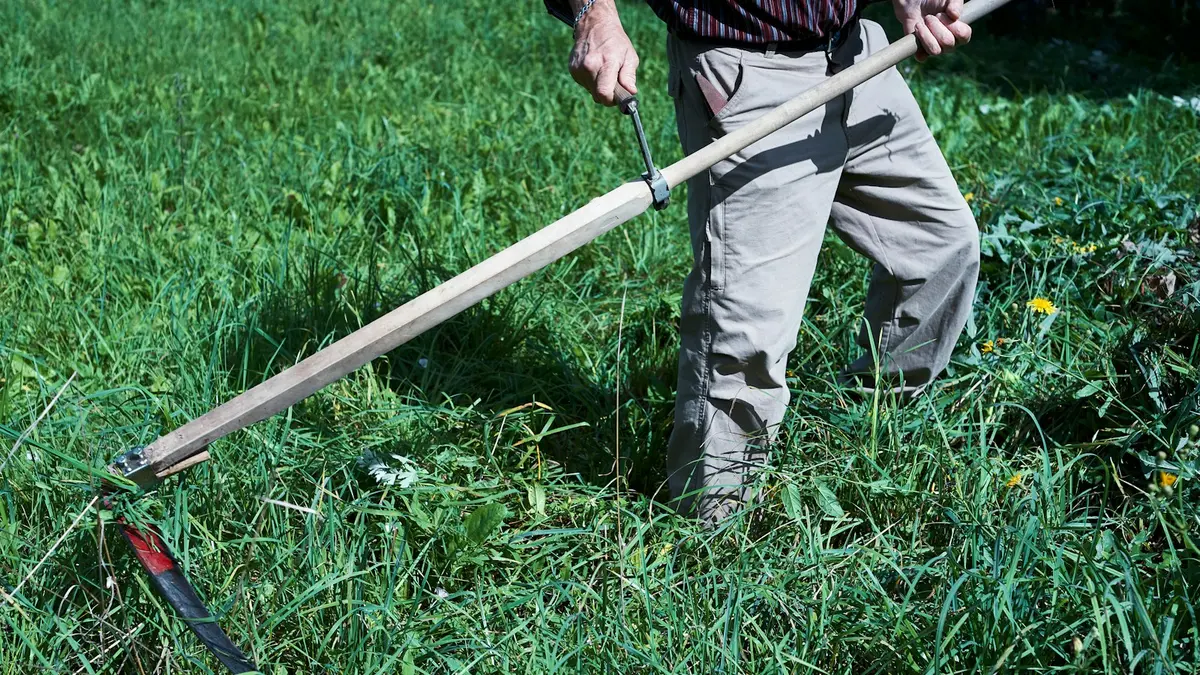
Source: Unsplash
When leaves are safe to mulch
Leaves are generally suitable for mower mulching when all of these conditions are true:
- They are mostly dry and loose rather than wet and pressed into the grass.
- The layer is light enough that the mower can cut and redistribute it without bogging down.
- Grass blades remain visible before you start, or the leaf layer can be reduced to that point first.
- The lawn has been cleared of twigs and other hard debris.
- The mower blade is in good condition and the mower is set up according to its manual for mulching.
A dedicated mulching mower or mulching blade can chop leaves more finely, but a standard rotary mower can often handle a light leaf layer. Virginia Tech notes that almost any rotary mower can work for leaf mulching, although mulching-oriented deck and blade designs are preferable. Virginia Tech
A dull or worn mower blade can leave larger fragments, reduce airflow under the deck, and make leaf pickup and recutting less effective. If leaf mulching suddenly becomes uneven, inspect the blade condition and follow the mower manufacturer’s maintenance instructions. See /sharpen-or-replace-lawn-mower-blades/ for signs that a blade needs attention.
How much leaf cover is too much?
Do not wait until fallen leaves form a deep blanket across the whole lawn. Heavy layers are harder for the mower to process and can leave clumps that shade the grass. Honda advises beginning while grass still shows through the leaf cover; where leaves completely cover the grass, rake them or bag them first. Honda owner’s manual
Virginia Tech cites research indicating that up to 6 inches of leaves may be mulchable in a single session, but that is not a universal capacity rating. It depends on leaf type, moisture, mower condition, deck design, engine or motor performance, and how slowly you mow. Treat that figure as an upper research example, not permission to force a mower through a deep pile. Virginia Tech
A better homeowner rule is to stop and reduce the layer if any of these happen:
- The mower begins leaving intact mats or thick windrows.
- The engine or motor sounds strained.
- Leaves collect beneath the deck or block discharge.
- The shredded layer hides the grass after you finish.
- The mower repeatedly stalls or needs you to push unusually hard.
Dry leaves work better than wet leaves
Dry leaves tend to circulate and cut more cleanly under the deck. Wet leaves can stick together, mat against the turf, clog the mower deck, and increase the load on the mower. The University of Georgia advises against trying to mulch wet leaves because they do not pick up well, even with a new blade. University of Georgia CAES
If the leaves are merely damp and you decide conditions are otherwise safe, work in a thinner layer and expect more passes. Do not mow if the lawn is slippery, the mower is clogging, or wet debris is making control difficult. Check your current mower manual for its operating limits and cleaning procedure.
A safe way to mulch leaves
1. Inspect the lawn before starting
Walk the entire mowing area. Remove sticks, branches, stones, wire, garden tools, toys, hoses, irrigation markers, and anything else that could be hit by the blade. Check especially beneath leaf piles, around trees, along fences, and near driveways where debris tends to accumulate.
2. Check the mower setup
Confirm that the mower is intended to mulch or can be configured for mulching according to its manual. Check that the blade and blade fasteners are in serviceable condition as specified by the manufacturer. Never reach beneath the deck or clear a blockage until the mower is shut down and made safe according to the manual.
For general mower upkeep between leaf seasons, see /how-often-to-clean-a-lawn-mower/ and /electric-lawn-mower-maintenance/.
3. Start with a light layer
Set a normal, lawn-appropriate cutting height rather than scalping the grass. Mow slowly enough to let the blade cut and recut the leaves. If the mower leaves strips of larger pieces, overlap the next pass or mow the area a second time from a different direction.
4. Check the result before continuing
The goal is not to create visible piles of shredded leaf material. Small fragments should settle into the turf canopy while grass remains visible. The University of Connecticut notes that leaf fragments must be reduced enough to settle into the turf without covering the grass blades and blocking needed sunlight. University of Connecticut IPM
5. Rake or bag the excess
If shredded leaves form clumps, rows, or a layer that covers the lawn, collect some rather than repeatedly forcing the mower through it. Use the material in a compost system if appropriate for your yard, or follow local yard-waste collection rules.
When to rake before mowing
Rake, blow, or bag before mowing when the lawn is fully hidden by leaves, the leaves are wet and matted, or debris is mixed throughout the pile. Raking first is also the safer choice after a windstorm, because fallen twigs and branches are easily concealed under leaves.
You should also rake before mowing when leaf accumulation is concentrated in beds, corners, against fences, or around shrubs. A mower cannot safely reach every place, and trying to push a mower into obstacles increases the chance of striking hidden material.
Protecting the lawn while mulching leaves
Finely chopped leaves can decompose in the lawn, but a thick layer can block light and hold excess moisture against the turf. Increase mowing frequency during heavy leaf fall rather than waiting for one large cleanup. This keeps each mowing manageable and reduces the chance that leaf debris will smother the grass.
The University of Connecticut recommends frequent leaf mulching and advises that no more than 20% of the lawn should remain covered by tree leaves after each mulching event. University of Connecticut IPM
Leaf type also matters. Thin leaves generally shred more readily than leathery or broad leaves. Tough leaves may need multiple passes, while pine needles, nuts, seed pods, and similar debris can complicate mowing and may be better collected instead of being treated as ordinary leaf mulch.
Basic mower safety for leaf cleanup
Wear eye protection when operating a mower because debris can be thrown from the cutting area. Keep other people and pets away while mowing, and follow the separation distance and safety instructions in your mower’s current manual. One electric mower manual, for example, instructs operators to inspect for debris and keep people and pets 100 feet away during operation. Electric mower manual
Avoid loose clothing and secure long hair. If leaf dust is heavy, Virginia Tech recommends eye protection and a mask over the mouth and nose to reduce exposure to dust and debris. Virginia Tech
Never try to clear a clogged deck with your hands while the mower is capable of starting or the blade can still move. Use the shutdown, disconnect, and blockage-clearing steps specified in your mower’s manual.
Bottom line
Use a lawn mower to mulch dry, manageable leaves—not twigs. Pick up every stick, branch, stone, wire, and hard object before mowing, even when it is partly hidden under leaves. Start before leaf cover becomes deep, mow slowly, make another pass if needed, and rake or bag excess material when the lawn is no longer clearly visible through the shredded leaves.
References
- “Leave” Them Alone: Lawn Leaf Management | VCE Publications | Virginia Tech. (n.d.). https://pubs.ext.vt.edu/430/430-521/430-521.html
- Mulching Leaves | Mulch Leaves With a Lawn Mower. (n.d.). https://www.popularmechanics.com/home/lawn-garden/how-to/a8400/how-to-mulch-leaves-with-a-lawn-mower-14786873
- Should You Mulch Leaves Into Your Lawn? | a Blade of Grass. (n.d.). https://abladeofgrass.com/blog/the-advantages-of-leaf-mulching
- What to Do With Fall Leaves: Mulch, Move, or Haul | Colonial Classics. (n.d.). https://www.colonialnewburgh.com/blog/what-to-do-with-fall-leaves
- OWNER’S MANUAL. (n.d.). https://cdn.powerequipment.honda.com/pe/pdf/manuals/00X31VL0D071.pdf
- Save time and build soil composition by mulching fallen leaves with mower | CAES Field Report. (n.d.). https://fieldreport.caes.uga.edu/news/save-time-and-build-soil-composition-by-mulching-fallen-leaves-with-mower
- 16” Electric Lawn Mower. (n.d.). https://images.thdstatic.com/catalog/pdfImages/1b/1b3db6a3-ff1a-4cf8-b6fb-f174ec7ad109.pdf
- Mulch-Mowing. (n.d.). https://www.leaveleavesalone.org/mulch-mowing
- How to Remove Small Twigs and Debris from Grass Easily. (n.d.). https://www.vevor.com/diy-ideas/how-to-remove-small-twigs-and-debris-from-grass?warmTaskId=20260520_080001
- Leaf Disposal & Mulch Mowing | Integrated Pest Management | College of Agriculture, Health and Natural Resources | University of Connecticut. (n.d.). https://ipm.cahnr.uconn.edu/leaf_disposal_mulch_mowing
 How Often Should You Clean and Maintain a Lawn Mower?
 Should You Sharpen or Replace Lawn Mower Blades?